- Home
- ›
- ›Best Fonts for Invoices (And How to Edit Them Quickly)
Best Fonts for Invoices (And How to Edit Them Quickly)
Choose the right fonts for professional invoices that get paid faster. Plus, learn how to customize typography in PDFs for maximum impact.
More on PDF Fonts
More on Edit PDF
More on Freelance Translation Invoice
This guide is for freelancers, small businesses, and teams who want invoices that are easy to read, look professional, and don’t slow down payment because of formatting issues.
Clear font choices help clients scan totals, dates, and line items quickly. This reduces back-and-forth and avoids delays caused by unclear or awkward layouts.
Below, you’ll find reliable invoice fonts, when each one works best, and where to avoid them, along with steps on how to customize fonts in PDFs for a clean look.
Best Invoice Fonts: Top Choices and When to Use Them
Choosing the right font for your business invoice isn’t just a design decision. It directly affects how professional, legible, and trustworthy your invoice appears.
Below are the best fonts for business invoices, each with specific strengths for different use cases:
| Font Name | Type | Best For | Pros | Cons |
|---|---|---|---|---|
| Arial | Sans-serif | Universal compatibility | Widely available, clean, easy to scan | Can feel generic |
| Calibri | Sans-serif | Microsoft environments | Modern, approachable, good for compact layouts | Limited to newer systems |
| Helvetica | Sans-serif | Premium branding | Timeless, highly legible, professional | Not always available, may require licensing |
| Open Sans | Sans-serif | Digital invoices | Web-optimized, neutral, excellent screen readability | Requires font loading |
| Times New Roman | Serif | Formal industries | Print-friendly, familiar, readable for long text | Can look outdated digitally |
| Verdana | Sans-serif | Screen reading | Excellent clarity at small sizes, accessible | Wide spacing increases page length |
| Roboto | Sans-serif | Mobile-first and SaaS invoices | Designed for screens, readable at small sizes, modern | Not installed on all systems |
| Inter | Sans-serif | Data-heavy invoices | Clear numerals, strong table readability, consistent spacing | Requires font embedding |
| Courier New | Monospaced | Item codes and references | Perfect alignment, universally available | Not suitable for body text |
| Tahoma | Sans-serif | Accessibility-focused invoices | Clear letterforms, readable at small sizes | Limited style range, less modern |
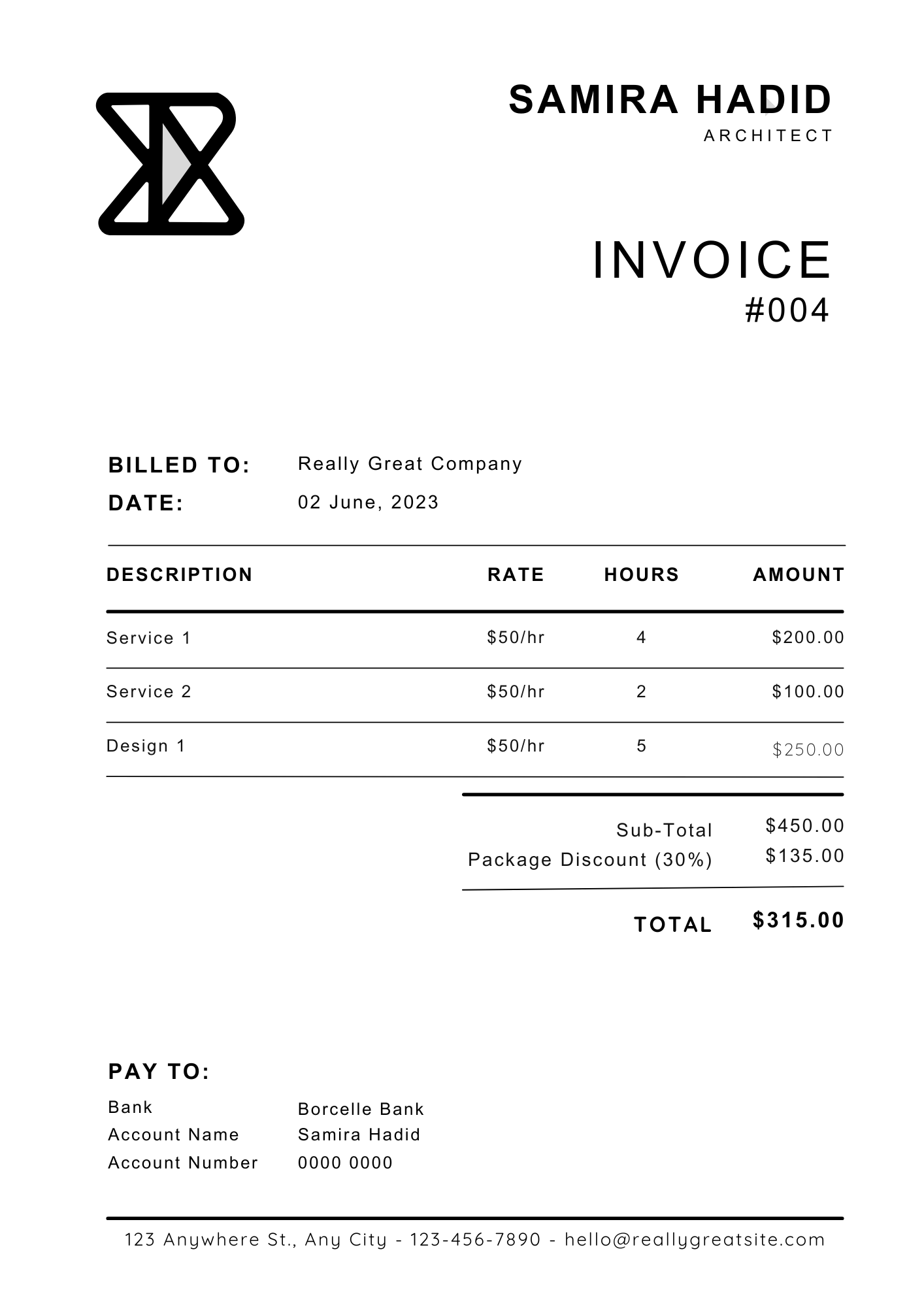
Invoice Typography Best Practices (Sizes, Hierarchy, and Legibility)
Beyond choosing the right font family, proper typography ensures your invoices are professional and easy to process. These guidelines help create clear visual hierarchy and improve readability.
Font Size Guidelines
Body text (line items, descriptions): 10-12 points
Important details (totals, due dates): 12-14 points
Headers (company name, “Invoice”): 14-18 points
Fine print (terms, payment details): 8-10 points minimum
Visual Hierarchy Rules
Company name and logo should be the largest text element.
Invoice total and amount due deserve prominent sizing.
Line items should be consistent and easily scannable.
Contact information can be smaller but must remain legible.
Screen vs Print Considerations: Sans-serif fonts like Arial and Calibri typically perform better on screens, while serif fonts like Times New Roman can enhance readability in print. Consider your primary delivery method when choosing between font types.
How to Change Fonts in a PDF Invoice With Smallpdf
Now that you know how important font styles are for your invoice, let’s look at how you can change the fonts in your PDF so that it looks professional and trustworthy.
Step 1: Open Smallpdf’s PDF Editor and upload your invoice (drag and drop works too).
Step 2: Click “Edit Text,” then select the text you want to change.
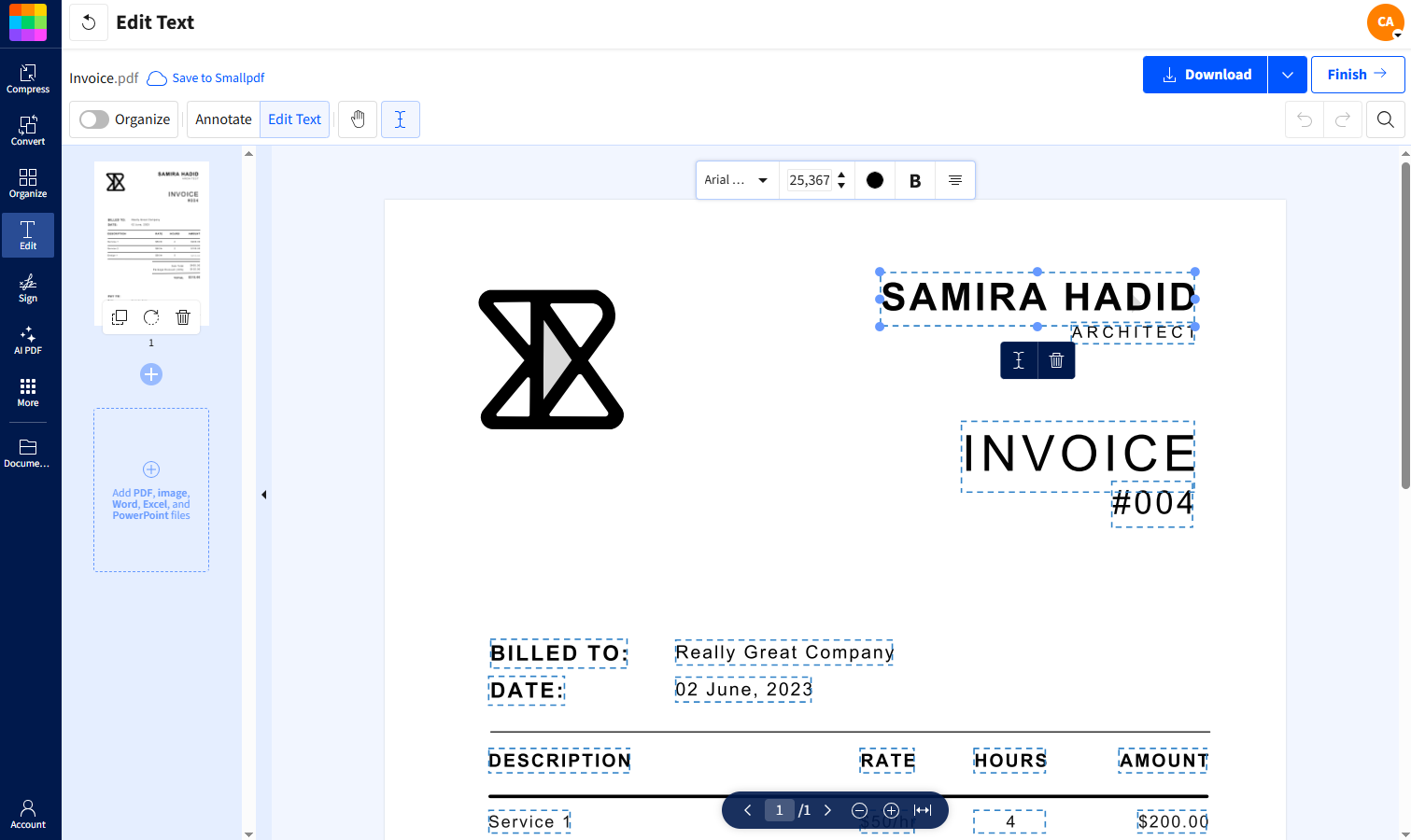
Step 3: Adjust the font size, color, or alignment as needed.
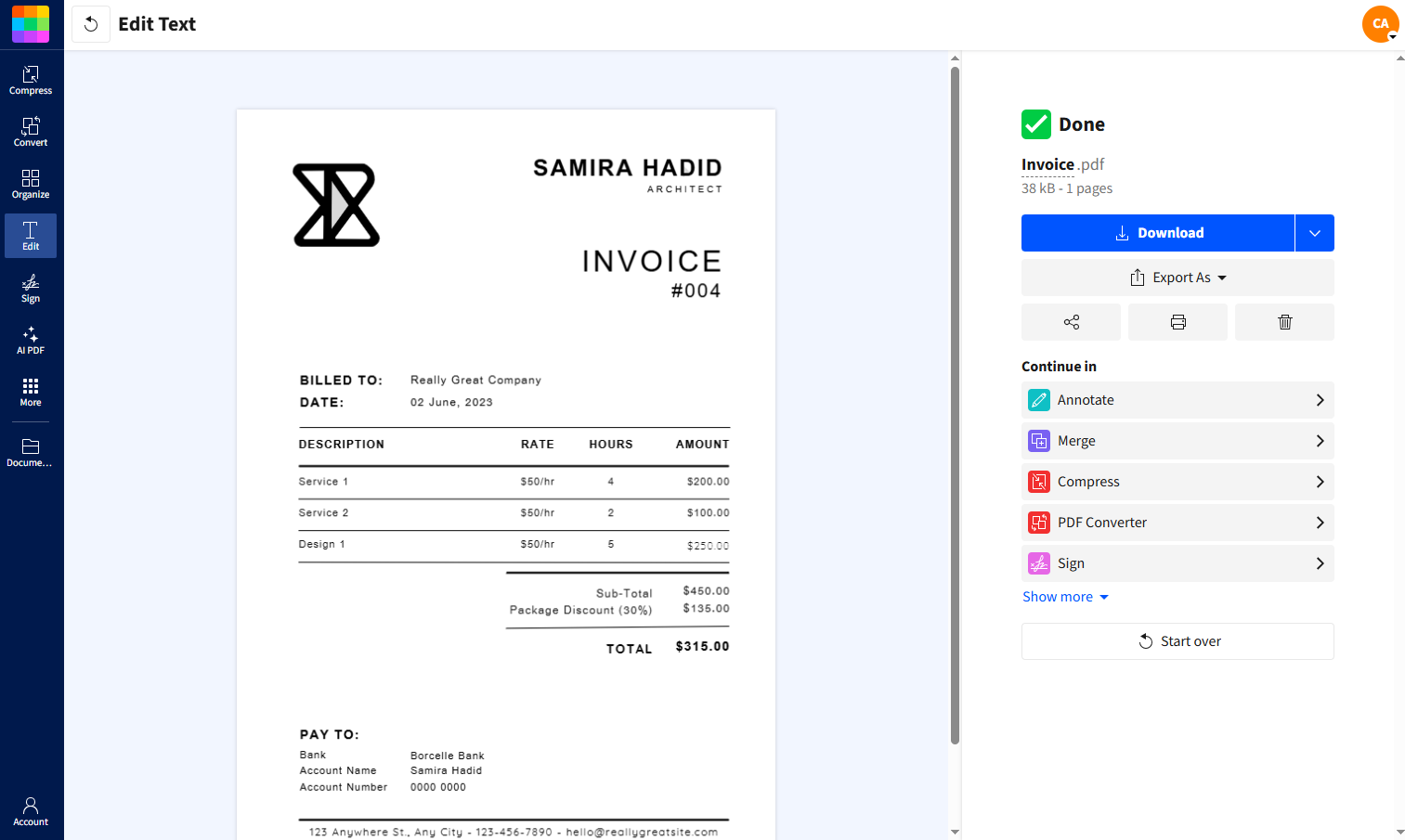
Step 4: Download your updated PDF or click “Finish” to print or share it.
Make Your Invoice Look Professional in Minutes With Smallpdf
Smallpdf’s PDF Editor lets you update invoice fonts directly in your browser, so you can make quick fixes without redesigning the document or switching software. Because everything runs online, you can edit invoices from any device and send them on immediately.
Files are handled securely, with automatic font embedding to keep layouts consistent when invoices are shared, downloaded, or printed. That means fewer formatting issues, fewer questions from clients, and smoother payment processing.
Start your free trial to access all Smallpdf tools and keep your invoices clear, consistent, and ready to send.
Frequently Asked Questions
What is the best font size for an invoice?
Most invoices work best with 10-12 pt for line items and descriptions, and 12-14 pt for totals and due dates. Headers like your company name or “Invoice” can be slightly larger, usually 14-18 pt, as long as the hierarchy stays clear.Should I use serif or sans-serif fonts on invoices?
Sans-serif fonts like Arial, Calibri, and Open Sans are easier to read on screens and are the safest choice for digital invoices. Serif fonts like Times New Roman can work for printed invoices or more traditional industries, but they may feel dated in online billing.Why do invoice fonts sometimes change when clients open the PDF?
Font changes usually happen when the original font isn’t embedded in the PDF. If the recipient’s device doesn’t have that font installed, it gets replaced automatically. Using a PDF editor that embeds fonts helps preserve spacing, alignment, and layout.Can I change invoice fonts without recreating the document?
Yes. If your invoice is already a PDF, you can edit the text and adjust fonts directly using a PDF editor, rather than rebuilding the invoice in Word or design software. This is especially useful for quick fixes before sending or resending invoices.Choose invoice fonts and format consistently with Smallpdf Pro