How To Fix Missing Fonts in a PDF
Are missing fonts messing up your PDF? Let’s get your text readable again on every screen so you can share it with anyone, with confidence.
More on PDF Fonts
More on Edit PDF
You open a PDF and something feels off. Text is replaced by boxes, symbols don’t make sense, or you see a warning about missing fonts. It’s a frustrating problem, especially when you’re about to share the file with a client, colleague, or printer.
In this guide, we’ll show you how to fix missing fonts in a PDF, how to re-embed fonts on Windows and macOS, and how to avoid font issues when converting or merging files so your document looks right everywhere.
Quick Fix: How To Fix Missing Fonts in a PDF Now
Quick fix: Use the editor below to upload your PDF and replace missing fonts with a supported one.
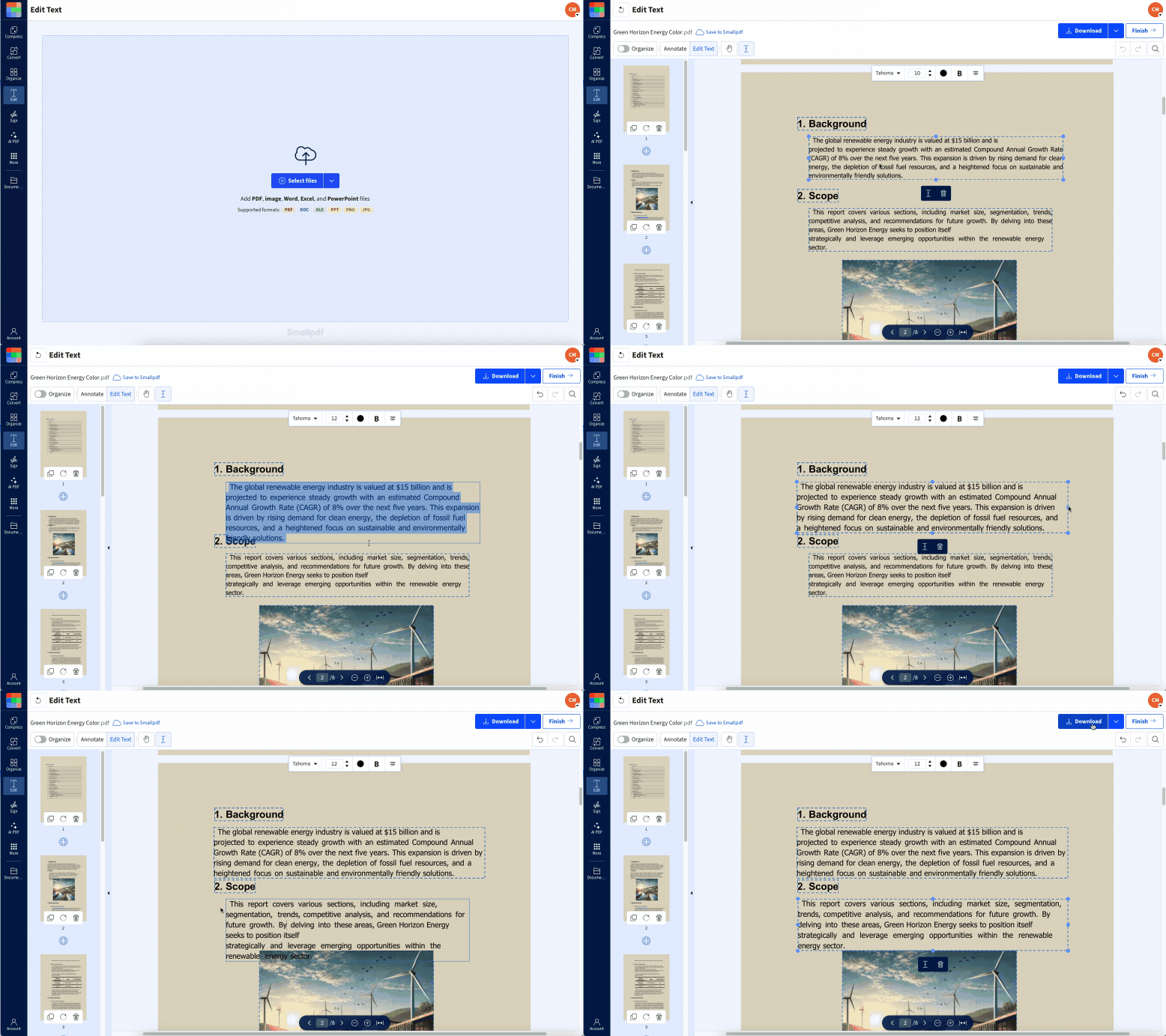
This simple change doesn’t restore a custom decorative font, but it makes your document readable and editable again without rebuilding it from scratch.
If you can’t use Edit PDF right away, try these quick alternatives:
Convert the file with PDF to Word, fix the font in Word, then export to PDF again.
Install the missing font on your device if you know its name and have a license.
Open the PDF in another viewer or in Smallpdf PDF Reader, since some viewers handle fonts better than others.
Why Fonts Go Missing in PDFs (Symptoms And Causes)
Missing fonts usually show up before you even think about fonts at all. You just noticed that the text looks off.
Common symptoms you’ll see:
Warning messages about missing fonts when you open the PDF.
Text that looks very different from the original document.
Why this happens behind the scenes:
Fonts weren’t embedded when the PDF was created, so they didn’t travel with the file.
Your device doesn’t have the same fonts installed as the original document.
PDFs from different sources use conflicting fonts and break when merged.
The file was converted from another format without proper font handling.
Embedded fonts live inside the PDF, while installed fonts live on your device. When a PDF only relies on installed fonts, and your device doesn’t have them, the viewer has to guess and substitute something else.
Replace Or Swap Fonts in Your PDF With Smallpdf Edit PDF
When you can open the PDF but some text looks broken or unreadable, Edit PDF gives you a direct way to fix what you see.
Change Fonts Directly in Edit PDF
Here’s how you can repair text inside the PDF itself:
Open Edit PDF.
Upload your file from your device or the cloud.
Click a text block that looks wrong.
Use the font dropdown to choose a standard font.
Adjust the font size if needed so lines don’t wrap in odd places.
Repeat for any other affected sections, then download the fixed file.
You can also add new text boxes over completely broken lines, then type the correct text in a clean font. That works well when only a few lines are corrupted.
Know The Limits of Font Substitution
Swapping fonts is a practical fix, but it does have limits:
Layout might shift slightly if the new font is wider or narrower.
Line breaks can move, especially in narrow columns or tight designs.
Decorative fonts won’t be replicated exactly by standard fonts.
That’s why it helps to scan the full page after you make changes. For important documents like contracts or marketing PDFs, always double-check headings, lists, and page breaks before sending the file.
Re-Embed Fonts From the Original File (Windows and macOS)
If you still have the original file, re-exporting the PDF with fonts embedded is usually the cleanest solution. Embedding means the font data is stored inside the PDF so anyone can view it correctly.
Embed Fonts on Windows
For Microsoft Word or PowerPoint on Windows:
Open your original document.
Click “File” > “Options” > “Save.”
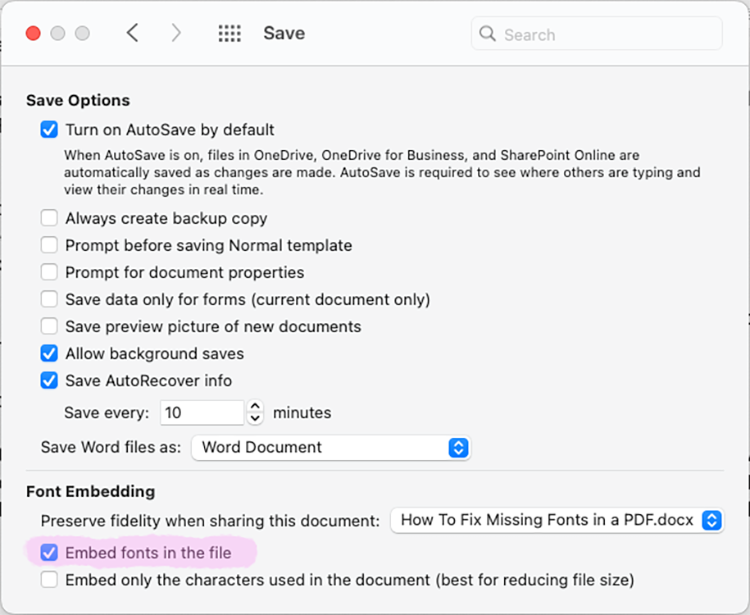
Under “Preserve fidelity when sharing this document,” check “Embed fonts in the file.”
Choose “Embed all characters” for maximum compatibility.
Click “File” > “Export” > “Create PDF/XPS” to save a new PDF.
Now reopen your new PDF. In many cases, missing letters and warning messages disappear because the fonts travel with the file.
Embed Fonts on macOS
For Microsoft Office on Mac:
Open your original document.
Click “Word” > “Preferences” > “Output and Sharing” > “Save.”
Check “Embed fonts in the file” under Font Embedding.
Use “File” > “Save As,” then select PDF as the format.
Choose “Best for electronic distribution and accessibility” in the PDF options.
Again, test the new PDF in your viewer and in Smallpdf. If everything looks correct now, your fonts are properly embedded.
Prevent Missing Fonts When Merging or Sharing PDFs
Merging or sharing PDFs can reveal font problems that weren’t obvious before. You combine files, send them to someone else, and they suddenly see missing headers or broken labels.
Pre-Merge Checklist for Fonts
Before you merge several PDFs into one:
Open each file and check for missing fonts or odd characters.
Re-export problem files with font embedding switched on.
Use similar font families across files when possible to avoid conflicts.
Test the merged result on a second device or viewer.
Once your individual PDFs look good, you can use Merge PDF to combine them. When fonts are embedded correctly, sections should stay intact when you send the final file around your team.
Advanced Troubleshooting for Persistent Font Problems
Sometimes you fix one issue, and another appears. When font problems keep coming back, it helps to look a bit deeper at how your PDFs are created and handled.
Use Preflight or Font Check Features
If your organization uses advanced PDF software, look for a “Preflight,” “Validate PDF,” or “Fix fonts” function. These features:
Scan the document for missing fonts, encoding issues, and format problems
Offer automatic fixes to embed available fonts or replace broken ones
Generate a report so you can see exactly which fonts caused trouble
If you’re not sure which feature to use, your IT team or design team can usually point you toward the right option inside your existing software stack.
Review Export Settings in Office and Design Apps
Export settings can quietly create font issues even when your document looks perfect before you save it.
Watch out for:
“Optimize for minimum size” options that strip out fonts during export.
Different versions of the same font on Windows and macOS.
Custom or corporate fonts that don’t embed properly in older app versions.
As a rule, choose “Best quality” or similar wording when you export a PDF, and make sure font embedding is turned on. The file will be larger, but it’s far more reliable when you share it widely.
Ask for Help With Complex or Legacy Files
Large, older, or heavily edited PDFs can carry years of font baggage. In those cases:
Share a sample file with your IT or design team.
Explain which pages show missing fonts and in which viewers.
Ask them to standardize fonts, clean up styles, and re-export the PDF.
You can then bring that cleaned file into Smallpdf, use Edit PDF for small tweaks, and share a version that behaves consistently for everyone.
Make PDFs Readable With Smallpdf, Including OCR
Missing fonts don’t have to derail your workflow. With Smallpdf, you can swap broken fonts in Edit PDF, re-export clean files with embeddable fonts, and use OCR for scanned pages that need real, editable text.
Because everything runs in your browser, you can upload from your device, Google Drive, Dropbox, or OneDrive, fix the problem, and download a readable PDF in just a few steps.
Start your free trial to unlock all our features and keep every PDF clear, consistent, and easy to share.
Frequently Asked Questions
Why is my font not showing up in a PDF?
Most of the time, the font wasn’t embedded in the PDF, or your device doesn’t have that font installed. Your viewer then substitutes a different font or shows boxes and symbols instead of letters.How do I add missing fonts to a PDF?
If you still have the original file, re-export the PDF with fonts embedded. If not, open the PDF in Smallpdf Edit PDF, select the affected text, and swap it for a standard font that you know works on most devices.How do I fix missing letters in a PDF?
Missing letters usually mean parts of the font can’t render correctly. Re-embed the original font from the source file or replace the font with Edit PDF so the viewer can draw every character properly.Why do fonts change when I send a PDF to someone else?
If fonts weren’t embedded, the PDF relies on fonts installed on each device. When the other person doesn’t have the same font, their viewer chooses a substitute, which changes how the text looks.Can I stop font issues when sharing PDFs?
Yes. Always embed fonts when exporting to PDF, use widely supported fonts for important documents, and test your PDFs on at least one other device before you send them to clients or partners.What if my PDF is a scan, not real text?
Scanned PDFs contain images of text, not actual text. You can use OCR, which stands for Optical Character Recognition, to turn those images into editable text. After that, you can control fonts again and export a clean, searchable PDF.Fix missing fonts in PDFs and export reliably Smallpdf Pro