- Home
- ›
- ›Searchable vs. Non-Searchable PDFs: Everything You Need To Know
Searchable vs. Non-Searchable PDFs: Everything You Need To Know
Turn scanned PDFs into searchable PDF files with OCR so you can find, copy, and reuse text in seconds on any device without manual retyping.
More on PDF OCR
More on Edit PDF
PDF Tips & Resources
When you work with scanned documents, screenshots, or photos turned into PDFs, searching for a particular name or number can feel impossible. A searchable PDF fixes that. Once your file becomes a searchable PDF, you can use “Ctrl+F” or “Command+F,” select text, copy it, and reuse it in a few clicks.
Before you start converting, it helps to understand the difference between searchable and non-searchable PDFs and how OCR fits in.
What is a searchable PDF file?
A searchable PDF file has a hidden text layer created by OCR, so you can search, select, and copy text instead of dealing with a flat image.
Searchable vs. Non-Searchable PDFs: Key Differences
A searchable PDF contains actual text your computer can read. A non-searchable PDF is just an image of text.
In a searchable PDF, you can:
Highlight single words or lines.
Press Ctrl+F or Command+F and jump to a word.
Copy text into another document.
In a non-searchable PDF, you usually:
Highlight the whole page instead of words.
Cannot search for text because there is no text layer.
Need to retype information manually.
Non-searchable PDFs are common when you scan paper documents or export images as PDFs. To fix this, you need OCR, which turns pictures of text into real, searchable characters.
How To Check If Your PDF Is Searchable
You can test your file in just a few seconds before running OCR.
Step 1: Try Selecting the Text
Open your PDF in any PDF reader. Then try to drag your mouse across a word or line.
If individual characters and words highlight, you have a searchable PDF.
If the whole page highlights as one block, your PDF is an image.
Step 2: Use the Search Shortcut
Next, press “Ctrl+F” on Windows or “Command+F” on macOS to open the search box. Type a word you can clearly see in the document.
If your viewer jumps to that word, you have a searchable PDF.
If nothing happens, your PDF is likely non-searchable.
If your PDF fails both tests, you are working with a non-searchable file and need OCR to create a searchable PDF.
How To Make a PDF Searchable Online With OCR
OCR (Optical Character Recognition) scans each page, detects the shapes of letters, and creates a text layer behind the page image. Smallpdf does this in your browser, so you don’t need to install software.
Step 1: Open Smallpdf PDF OCR
Go to the Smallpdf PDF OCR feature in your browser. You can open it on any device that has internet access.
Upload your PDF in the OCR tool area below, either from your device or by importing it from Google Drive, Dropbox, or OneDrive.
Step 2: Upload Your Non-Searchable PDF
Click “Choose File” or drag and drop your PDF into the upload area.
If you work with many scans, start with one file first to check the OCR result before converting a full batch.
Step 3: Let Smallpdf Apply OCR
Smallpdf analyzes each page and turns the image of text into machine-readable text.
During this step, Smallpdf creates a new version of your PDF with a hidden text layer. The original layout and images stay in place.
Step 4: Download Your Searchable PDF
When OCR finishes, click “Download” to save the new searchable PDF.
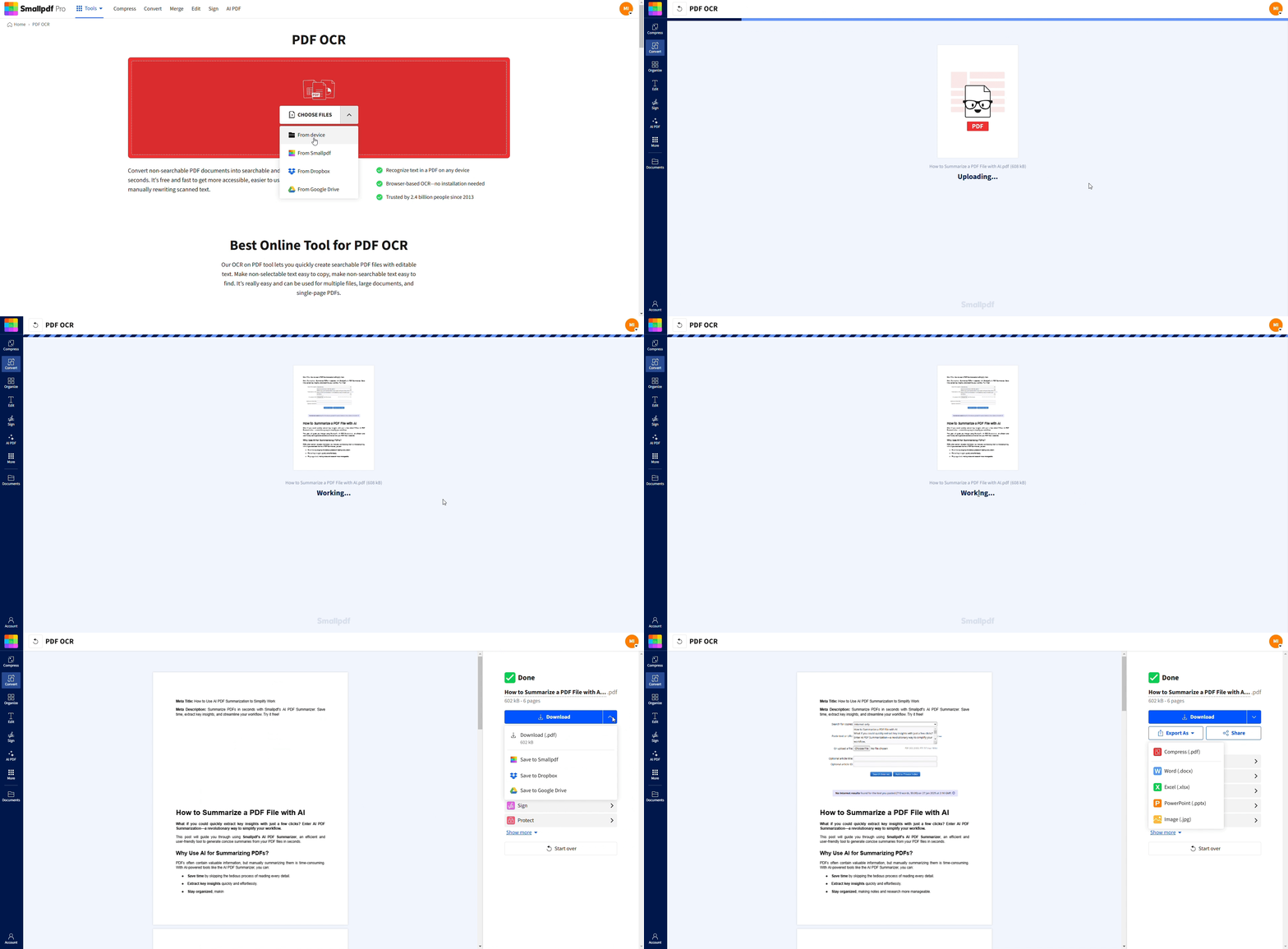
Open the file, press “Ctrl+F” or “Command+F,” and try searching for a word. You should see instant results. You can also try copying a sentence to confirm that the text is now selectable.
For a more visual guide, you can add a screenshot showing the Smallpdf PDF OCR interface with the upload zone and progress indicator.
Convert Multiple PDFs to Searchable Format (Pro)
If you have a whole folder of scans, converting one at a time is not practical. Smallpdf Pro lets you run OCR on multiple PDFs in one go.
Open Smallpdf PDF OCR while signed in with a Pro account.
Upload several PDFs at once from your device or connected cloud storage.
Start OCR and let Smallpdf process all files in the background.
Download your new searchable PDFs and store them in your archive.
Batch OCR is useful for digitizing contracts, invoices, HR files, or historical records that you want to search later.
Convert Between Searchable PDFs and Word Documents
Sometimes you need to edit the text, not just search it. Moving between PDF and Word helps you keep everything editable and searchable.
PDF to Word With Searchable Text
If you start from a searchable PDF, you can convert it directly to Word.
Open Smallpdf PDF to Word.
Upload your searchable PDF.
Download the Word file and edit the text as needed.
Because the text is already recognized, you keep formatting and readability in most cases.
Word to Searchable PDF
When you export from Word to PDF, you automatically get a searchable PDF.
Open Smallpdf Word to PDF.
Upload your Word document.
Download the new PDF.
Since Word uses real text, the resulting PDF already includes a text layer. You don’t need OCR in this case.
Make a PDF Searchable on Mobile
You can create a searchable PDF even when you only have your phone.
Make a Searchable PDF on iPhone or iPad
Install the Smallpdf mobile app for iOS.
Open the app and use the camera to scan your document, or import an existing photo.
Enable text recognition or OCR in the settings if the app offers it.
Save or export your file as a searchable PDF and share it by email or cloud storage.
Make a Searchable PDF on Android
Install the Smallpdf app for Android.
Use the scan or “Create PDF” feature to capture your document.
Turn on OCR or “Text recognition” inside the app.
Export your PDF and test it by searching for a word inside the document.
You can also send these PDFs to your computer and run them through Smallpdf PDF OCR again if you want a second pass.
Troubleshoot OCR Quality and Recognition Issues
OCR is powerful, but it’s not perfect. Scan quality, language, and fonts all affect the final result. Smallpdf can help solve many of the common problems.
1. Fix Low-Quality Scans
If the original scan is blurry, dark, or skewed, OCR will struggle.
Rescan the document at 300 DPI or higher.
Make sure the page is flat and well-lit.
Use a scanner instead of a phone camera when possible.
Once you have a clearer file, upload it again to Smallpdf PDF OCR and rerun recognition.
2. Correct Language and Character Issues
If you see words full of strange characters, there might be a language mismatch.
Check that your OCR settings match the document language, where supported.
Avoid unusual decorative fonts and heavily stylized text.
Smallpdf’s OCR engine works with many major languages and common fonts, so rerunning OCR with better settings can significantly improve results.
3. Recover Missing or Jumbled Text
Sometimes, parts of the page stay unreadable or come out jumbled.
Increase contrast before you scan or use a scanner setting that reduces background noise.
Avoid scribbles, stickers, or stamps over critical text.
For handwriting, check if the text is clear and uniform. OCR works best with printed characters.
If some parts still fail, you can open the searchable PDF in Smallpdf Edit PDF or a word processor after conversion and manually fix the few lines that need correction.
Why Use Smallpdf To Make PDFs Searchable
Smallpdf runs in your browser, so you don’t need to install heavy software just to make a searchable PDF. You can access it from Windows, macOS, Linux, or mobile browsers.
Once your PDF is searchable, you can:
Compress it with Compress PDF for faster sharing.
Add signatures with eSign PDF for quick approvals.
Merge several searchable PDFs with Merge PDF into one file.
Export text to other formats using PDF to Word or PDF to Excel.
Smallpdf uses strong encryption, automatic file deletion, and is GDPR compliant, so you can work with sensitive documents while keeping data protection in mind.
Want to Make PDF Searchable?
Frequently Asked Questions
What is OCR and how does it work?
OCR, or Optical Character Recognition, scans each page of your PDF, finds the shapes of letters, and turns them into digital text. The OCR process creates a hidden text layer behind the page image so you can search, select, and copy text inside your PDF.How do I batch convert multiple PDFs to searchable format?
To batch convert several PDFs, use Smallpdf Pro with the PDF OCR feature. Upload all your scanned PDFs at once, start OCR, and download the processed files. This is helpful when you need to digitize archives, invoices, or project folders in one session.Why can’t I select text in my PDF?
If you can’t select text, your PDF is likely a scanned image or a screenshot saved as a PDF. There is no text layer to interact with. Run the file through Smallpdf PDF OCR, download the new version, and then test again using Ctrl+F or Command+F.Does OCR work with handwritten text?
OCR works best with clear, printed text. Some advanced engines can recognize neat handwriting, but results vary based on writing style and scan quality. For critical information in handwriting, you may still need to review and correct the recognized text manually.What languages does Smallpdf OCR support?
Smallpdf OCR supports many widely used languages such as English, Spanish, French, German, Italian, Portuguese, and more. In most cases, the engine can detect the document language automatically, but better scan quality always helps accuracy.How can searchable PDFs help with accessibility?
Searchable PDFs are important for accessibility because screen readers and assistive tools can only read real text. When you create a searchable PDF, people using screen readers can navigate headings, read paragraphs, and search for key terms more easily.Is my data secure when using online OCR?
Yes, Smallpdf encrypts file transfers, uses secure processing, and deletes your files automatically after a short period. Smallpdf follows GDPR requirements and does not use your documents as training data or share them without your consent.Convert non-searchable PDFs into searchable documents using Smallpdf Pro