- Home
- ›
- ›Google Translate vs. Smallpdf: Best Document Translator
Google Translate vs. Smallpdf: Best Document Translator
Google Translate can break PDF formatting and leave you stuck with messy output. Here’s how to get properly formatted PDFs you can actually use.
More on Translate PDF
AI Tools & Guides
PDF Tips & Resources
You want a translated file you can download as a PDF and share right away, without fonts jumping, tables collapsing, or pages turning into a wall of text.
Google Translate can translate PDFs in its “Documents” view, but the experience depends heavily on your file.
Smallpdf Translate PDF is built for full-document output, so you can translate and download a usable copy in a single flow.
So, can Google Translate convert PDF to PDF?
Yes, Google Translate can translate a PDF and you can download the translation, but it’s not a PDF conversion workflow. Formatting can shift, and scanned image text isn’t translated.
Google Translate PDF Translation: Step-by-Step Guide
Google Translate works best for simple, text-based PDFs with clean formatting.
Step 1: Open Google Translate
Go to Google Translate in your browser, then click “Documents.”
Step 2: Pick Your Languages
Choose the source language (or select “Detect language”) and your target language.
Step 3: Upload Your PDF
Click “Browse your computer” (or drag and drop) and select your PDF. Google Translate supports .pdf, .docx, .pptx, and .xlsx for document translation.
Step 4: Start the Translation
Click “Translate” and wait for processing to finish.
Step 5: Download the Translation
When it’s ready, click “Download translation.” The button text can vary depending on the document type.
Step 6: Check the Output Before You Share It
This is where most people hit friction. After download, scan a few pages for layout shifts, missing line breaks, and table alignment.
What you’ll notice on tricky PDFs
Multi-column pages may reflow into a single column.
Tables can lose cell spacing or line breaks.
Fonts may look different from the original.
Google Translate’s hard limits
Document uploads are limited to 10 MB.
PDFs must be 300 pages or fewer.
Document translation isn’t available on mobile screens.
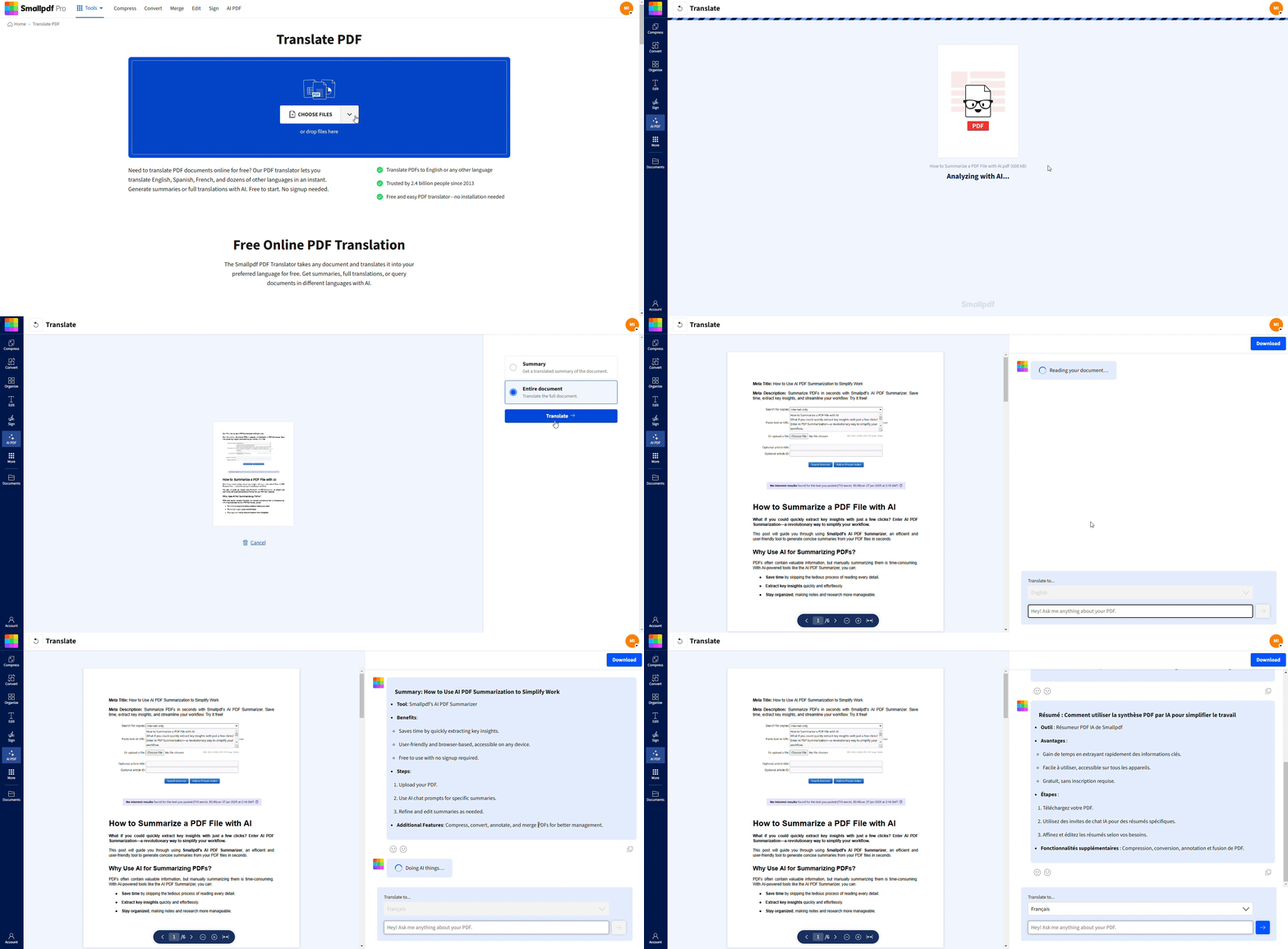
Smallpdf Translate PDF: Step-by-Step Guide
Smallpdf Translate PDF is designed for people who want a translated file they can download and use right away. It supports summaries and full-document translation, so you can pick the output that matches your goal.
Step 1: Open Smallpdf Translate PDF
Go to Translate PDF and get your file ready on your device, Google Drive, Dropbox, or OneDrive.
Step 2: Upload Your Document
Drop in your PDF. If you’re starting from Word, PowerPoint, or Excel, you can upload those formats too, then keep the workflow the same.
Step 3: Choose Your Output Type
Pick “Summary” if you only need the key points, or choose “Full Document Translation” when you need the whole file translated.
Step 4: Select Your Target Language
Choose the language you need, then start translation.
Step 5: Download Your Translated PDF
When the translation finishes, download the translated file and share it immediately.
Google Translate vs. Smallpdf: What Changes in Your PDF
Here’s the practical difference. Both can translate text, but the output experience is not the same.
| Feature | Google Translate (Documents) | Smallpdf Translate PDF |
|---|---|---|
| Downloadable output | Download translation is available | Downloadable output built into the workflow |
| Formatting consistency | Can shift on complex layouts | Designed for full-document output |
| Large/long PDFs | 10 MB max, 300-page PDFs max | If your file is heavy, you can prep it with Smallpdf first |
| Scanned PDFs | Text in scanned PDF pages isn’t translated | OCR-supported workflows are available (limits may apply) |
| Mobile access | Not available on mobile screens | Browser-based workflow across devices |
Translating Scanned PDFs and Image Text
If your PDF is a scan, translation fails for a simple reason. The “text” is actually an image, so the translator can’t select or interpret it like real text.
With Google Translate, you can see text from images and scanned PDF pages in the output, but it isn’t translated.
With Smallpdf, OCR-based workflows are available, which turn scanned images into readable text first, then make translation possible. Some limits can apply depending on the file and plan.
If you want more control, a reliable workaround is:
Run the scan through PDF OCR,
Fix spacing or broken lines in Edit PDF (or convert with PDF to Word),
Then translate the cleaned document.
Troubleshooting PDF Translation Problems
Even a good translator can stumble on real-world PDFs. Here are the issues people run into most often, plus fixes that keep you moving.
1. Your PDF Won’t Upload
If you’re using Google Translate, check size and page limits first (10 MB and 300 pages).
If your file is too large, run it through Compress PDF to shrink it before translating.
2. The PDF Is Password-Protected
Google Translate may fail or skip content when a PDF is locked. Use Unlock PDF first, then translate your clean copy.
3. The Translation Looks Scrambled in Tables or Columns
This usually happens on multi-column layouts and complex tables. A fast fix is to convert the PDF to an editable format first, adjust spacing, then translate and export back to PDF.
4. Your Scanned PDF Translates Into Nonsense
That’s almost always missing OCR. Google Translate won’t translate scanned image text in PDFs. Use an OCR step first, then translate.
5. Right-To-Left Languages Look Off
Right-to-left scripts like Arabic and Hebrew may need extra spacing and alignment checks after translation. Always review headings, lists, and table labels before sharing.
When Smallpdf Makes More Sense Than Google Translate
Google Translate is fine for quick reads. Smallpdf is the better fit when the translated file must look like a real document.
You’ll usually prefer Smallpdf when you’re translating:
Contracts, policies, and compliance PDFs where layout matters
Reports and proposals with tables, headings, and branded formatting
Scans and photographed pages that need OCR before translation
Multi-file work where you want one workflow for prep, translate, and export
Privacy and Security When Translating PDFs
If your document includes client info, legal text, or financial details, don’t treat translation like a casual copy-paste job. Check how the service handles uploads and deletion.
With Smallpdf, we secure file transfers with advanced TLS encryption, follow GDPR, and maintain ISO/IEC 27001 certification. Files are also removed automatically after an hour of processing for most tasks.
Translate Your PDF and Download a Usable Copy
If your goal is a translated PDF you can download, share, and trust for real work, start with Smallpdf Translate PDF.
Upload from your device or cloud storage, choose a summary or full translation, then download a clean output you can actually use.
Frequently Asked Questions
Can Google Translate translate a PDF and download it?
Yes. Google Translate supports PDFs up to 10 MB, and you can download the translation. PDFs must be 300 pages or fewer.Why does Google Translate mess up my PDF formatting?
PDFs are layout-heavy. Columns, tables, and custom fonts don’t always translate cleanly, so the output can reflow or shift spacing. This is common on complex documents.Can Google Translate translate scanned PDFs?
Not fully. Text inside scanned PDF pages can appear in the output, but it isn’t translated.How do I translate a scanned PDF with Smallpdf?
Use an OCR-supported workflow first, then translate. Smallpdf provides OCR-based options to turn scans into readable text before translation, and some limits may apply depending on your plan and file.What should I do if my PDF is too large to translate?
For Google Translate, you’ll need to stay under 10 MB and 300 pages. On the Smallpdf side, compress first with Compress PDF, or split the file into sections, then translate in parts.Is it safe to translate confidential PDFs online?
It depends on the service. With Smallpdf, file transfers use advanced TLS encryption, we’re GDPR compliant, and ISO/IEC 27001 certified. Together, you can rest assured your documents stay private and safe.Translate scanned and structured documents on Smallpdf Pro