The Hidden Cost of Bad File Names
Disorganized file naming systems are quietly draining time, money, and productivity across modern workplaces.
File naming might seem like a small detail, but it has a real impact on how smoothly work gets done. When files are hard to find or unclear, even simple tasks take longer, and mistakes start to creep in.
To understand how common this problem is, Smallpdf surveyed 1,000 working professionals across the United States. As a platform focused on making document tasks faster and easier, Smallpdf wanted to see how file-naming habits affect productivity, accuracy, and day-to-day workflows.
Key Takeaways
Workers lose 2.3 hours a week to searching for files they can't quickly locate - that's an estimated $4,160 per employee, per year.
More than 1 in 3 professionals (37%) admit they've copied a file and forgotten to rename it.
51% of professionals have wasted time redoing work because they couldn't find the original file.
More than 1 in 3 workers (35%) have sent the wrong version of a file to a client or colleague due to confusing file names.
1 in 10 professionals have received a direct complaint from a client or stakeholder due to file name confusion.
1 in 3 professionals has no consistent file-naming system.
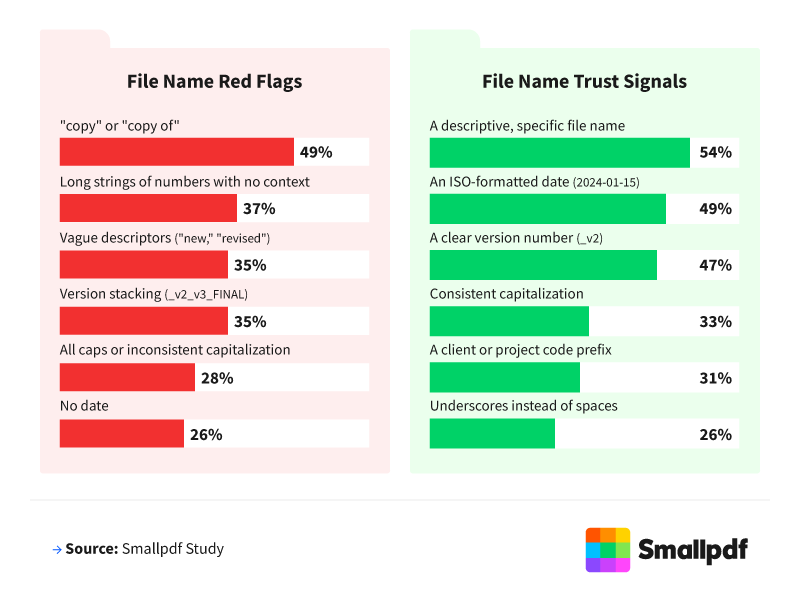
The top 3 file name red flags professionals look for are "copy" or "copy of" (49%), long strings of numbers with no context (37%), and vague descriptors (35%).
36% of professionals say file disorganization has negatively affected their team's productivity.
The True Cost of File Name Chaos
Even small file naming issues can quickly snowball into lost time, repeated work, and costly mistakes across teams.
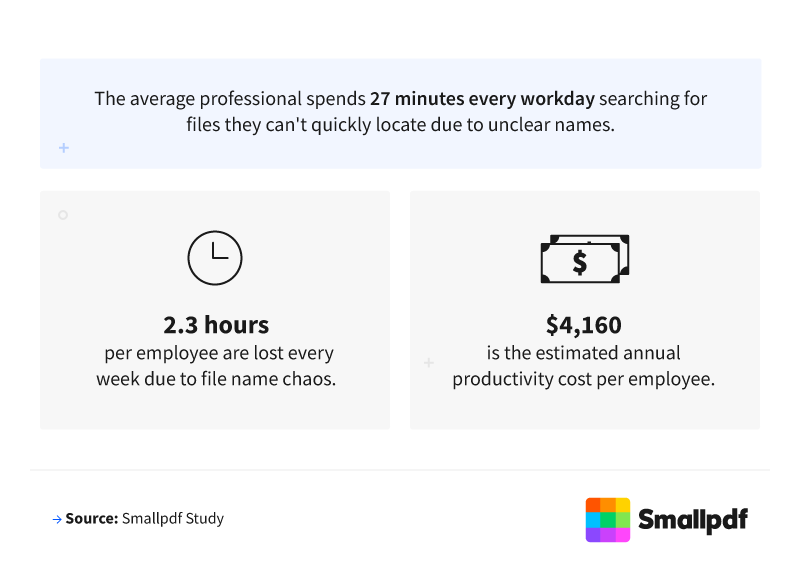
Workers lose 2.3 hours a week to searching for files they can't quickly locate - that's $4,160 per employee, per year.
55% of professionals say their team lacks a shared or standardized file naming convention.
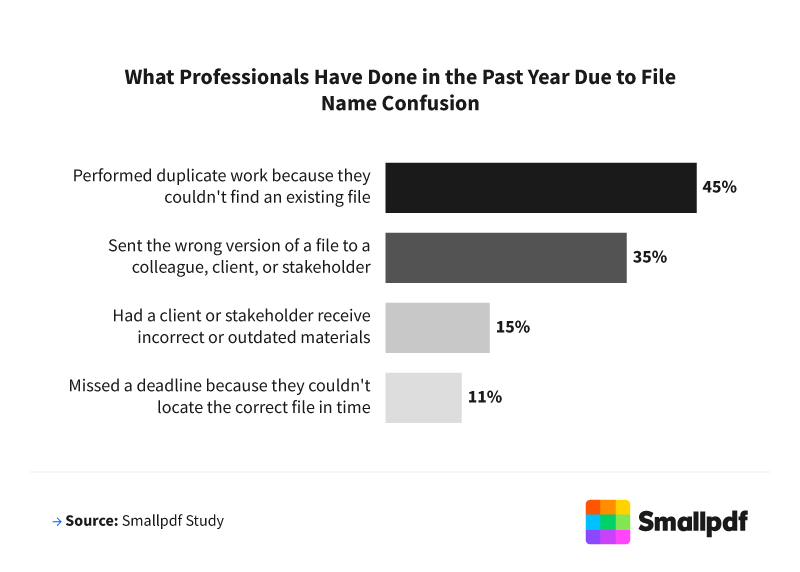
Nearly half of professionals (45%) have performed duplicate work because they couldn't find an existing file.
35% have sent the wrong version of a file to a colleague, client, or stakeholder, with Gen Z and millennial workers most likely to have done so (38% each).
15% of professionals have had a client or stakeholder receive incorrect or outdated materials due to filename confusion, and 1 in 10 have received a direct complaint as a result.
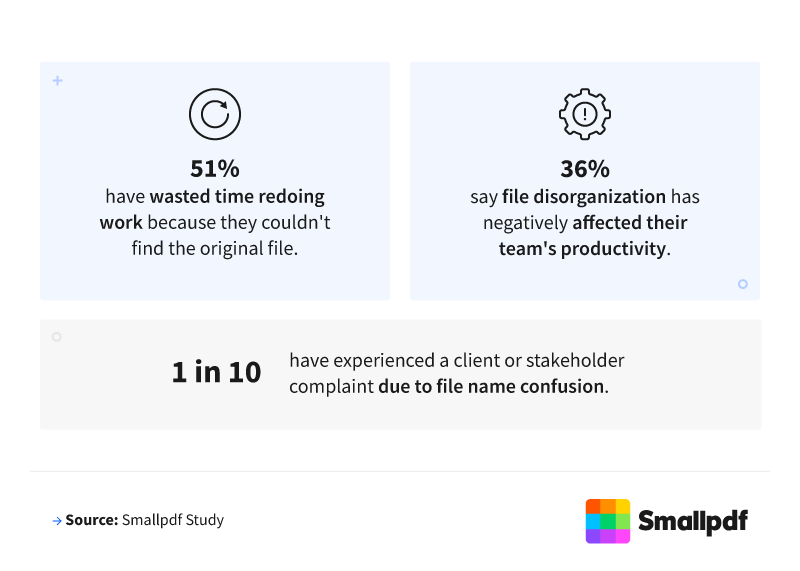
51% have wasted time redoing work because they couldn't find the original file.
Gen Z workers are the most likely to have missed a deadline due to file confusion (19%).
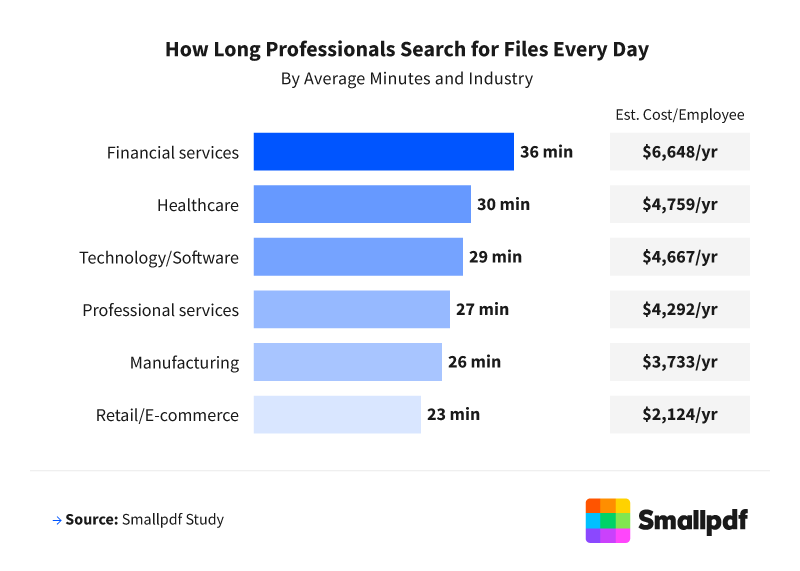
Financial services workers spend the most time per day searching for files (36 min), followed by healthcare (30 min) and technology (29 min).
Daily file searches cost finance companies an estimated $6,648 per employee per year.
The File Name Hall of Shame
Common naming habits and inconsistencies reveal why so many professionals struggle to stay organized.
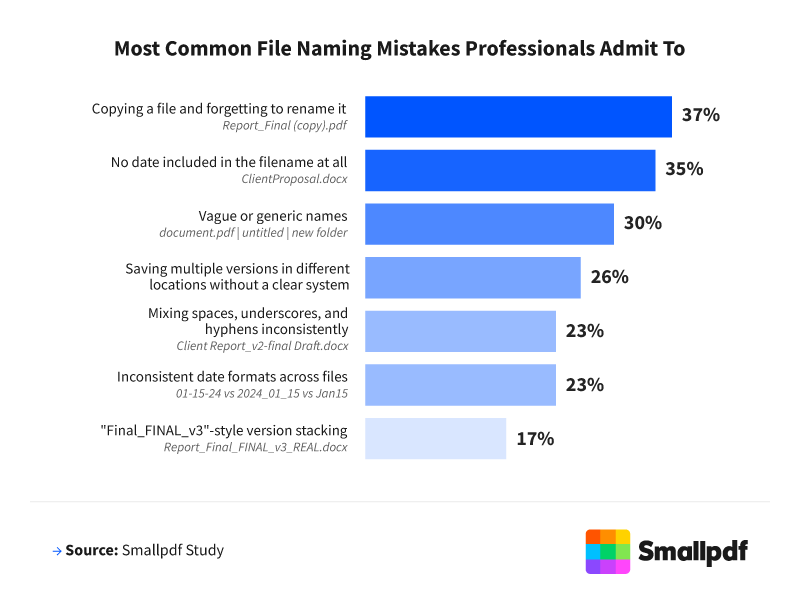
64% of professionals encounter file-naming or versioning issues at least occasionally when converting, sharing, or compressing documents across tools.
The most commonly committed file-naming error is copying a file and forgetting to rename it, reported by 37% of professionals, followed by omitting a date (35%) and using vague or generic names like "untitled" (30%).
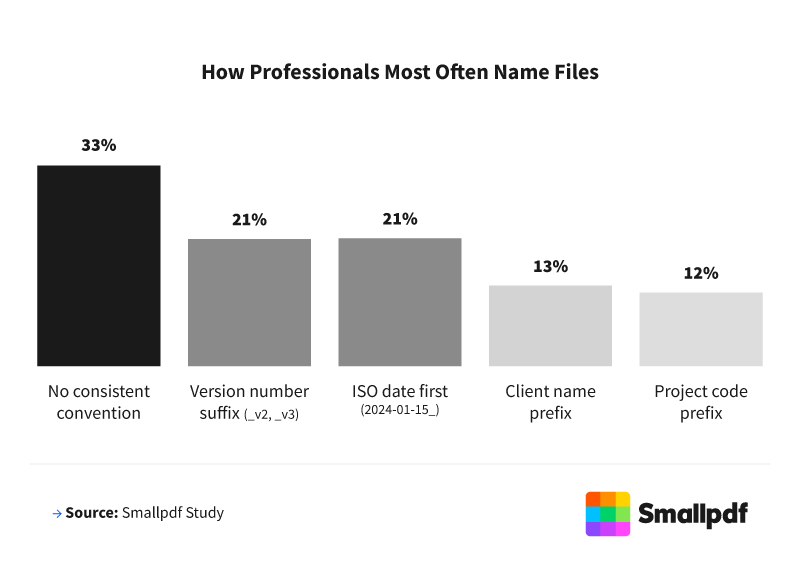
When asked how they most often name their files, 1 in 3 professionals (33%) say they have no consistent file naming convention.
Financial services workers are most likely to use version-number suffixes as their primary convention (26%), while technology workers skew toward ISO date first naming (25%).
"Copy" or "copy of" is the single biggest red flag professionals look for in a filename, flagged by nearly half (49%), yet copying without renaming is simultaneously the most commonly admitted sin.
The most trusted signal of a well-named file is a descriptive, specific filename (54%), ranking above an ISO-formatted date (49%) and a clear version number (47%).
Practical Steps to Fix File Naming Chaos
Small changes to how files are named and organized can make a big difference in daily work. Clear systems help teams find what they need faster and avoid costly mistakes. Here are a few tips:
Use clear, descriptive file names so anyone can understand the content at a glance.
Add dates and version numbers to avoid confusion between file versions.
Create a shared naming system so everyone follows the same structure.
Regularly clean up folders to remove duplicates and outdated files.
With a few consistent habits in place, teams can spend less time searching and more time getting meaningful work done.
Methodology
Smallpdf commissioned a survey of 1,000 full-time professionals across the United States in March 2026 to better understand file-naming habits and their impact on productivity. Respondents were screened to ensure active employment and represented a wide range of industries, including technology/software (19%), healthcare (16%), financial services (9%), professional services (8%), retail/e-commerce (8%), manufacturing (6%), and others (35%).
The sample included millennials (59%), Gen X (26%), Gen Z (11%), and baby boomers (4%). The gender distribution was 52% men and 47% women. Time-based averages were calculated using the interquartile range method to remove outliers and improve accuracy. The estimated annual cost per employee is based on the average time spent daily searching for files (IQR-cleaned) and respondents' self-reported annual income. Daily search time was multiplied by 260 workdays and divided by 60 to get annual hours lost, then multiplied by an implied hourly rate (annual income divided by 2,080 work hours) to produce a dollar figure.
About Smallpdf
Smallpdf is a simple, user-friendly platform that helps millions of people manage documents more efficiently. From compressing and converting files to editing and e-signing PDFs, Smallpdf makes it easier to keep files organized, consistent, and easy to find, helping professionals and teams avoid confusion and stay productive.
Fair Use Statement
The data and insights shared here are intended for noncommercial use. When citing or distributing this information, please credit Smallpdf and include a link to the original source.
Related Articles