PDF vs EPUB vs MOBI: Best E-Book Format
Compare PDF vs EPUB to understand how layout, readability, and device support differ so you can choose the best e-book format for your needs.
Ebook Tool & Guides
PDF Reading Tools & Guides
More on PDF Converter
EPUB adapts to any screen, while PDF keeps every line and image locked in place. MOBI mostly lives on older or Kindle-specific devices.
In this guide, we focus on PDF vs EPUB first. Then, we show where MOBI still matters, and how Smallpdf can help when you choose PDF as your final format.
PDF vs EPUB: Key Differences
At a high level, EPUB gives you flexible, reflowable text, while PDF gives you fixed, print-ready pages. That choice affects how your book looks, how easy it is to read, and how well it prints.
Here’s a side-by-side view of EPUB vs PDF:
| Aspect | EPUB | |
|---|---|---|
| Layout | Reflowable text that adapts to screen size | Fixed layout that matches the original page |
| Reading comfort | Great on phones, tablets, and e-readers | Can require zooming and panning on small screens |
| Font and display | Lets you change font, size, spacing, and themes | Very limited changes, mostly zoom only |
| Printing | Not ideal for printing, layout shifts with text | Designed for consistent, accurate printing |
| Visual-heavy content | Can struggle with complex diagrams and dense tables | Handles charts, images, and complex layouts very well |
| Interactivity | Supports links, media, and interactive elements | Supports forms and links, rich media is less consistent |
| Accessibility | Works well with screen readers and large text options | Depends on tagging; scanned PDFs can be hard to access |
| File size | Often smaller for text-heavy books | Can be larger, especially with high-resolution images |
| Best use cases | Novels and reading-first e-books | Manuals, textbooks, contracts, and printable documents |
If you mostly care about a smooth reading experience, EPUB usually wins. If you need every page to look the same on screen and on paper, PDF is the safer choice.
When To Use PDF vs EPUB
Your choice depends on how your readers will use the file. Start by thinking about reading comfort versus layout control.
Use EPUB When
EPUB works best for reading-first content that should feel like a digital book, not a scanned document. Choose EPUB for:
Novels, fiction, and narrative non-fiction
Long-form reading on phones, tablets, and e-readers
Situations where readers want to adjust text size or themes
Accessible e-books that work well with screen readers
Use PDF When
PDF shines when precise layout matters more than flexible text. Choose PDF for:
Textbooks, workbooks, and technical manuals
Documents with charts, diagrams, or multi-column layouts
Forms, contracts, and official documents that may need printing
Files you want to share across teams, devices, and platforms
If you decide to publish in PDF, you can use PDF Converter to turn Word, PowerPoint, and image files into clean, shareable PDFs, then use Compress PDF to reduce file size for faster downloads and smoother sharing.
Want to convert a file to PDF?
What Is EPUB?
EPUB, short for “Electronic Publication,” is an open e-book format designed for digital reading. It behaves more like a responsive web page than a static document, which is why it feels so natural on small screens.
The key feature is reflowable text. Instead of locking text to fixed pages, EPUB allows the content to rearrange itself to fit any screen size. On a phone or small tablet, the text adjusts so you can read line by line without sideways scrolling or constant zooming.
EPUB also supports bookmarks, hyperlinks, internal navigation, and even embedded media such as audio or video. Many reading apps let you change fonts, adjust line spacing, switch to dark mode, and tweak margins, all while staying inside the same file.
Most major e-book platforms support EPUB, including Apple Books, Google Play Books, Kobo, and many modern e-readers. Newer Kindle workflows can also accept EPUB via “Send to Kindle,” even if the file is converted behind the scenes.
What Is PDF?
PDF stands for “Portable Document Format.” It’s built to preserve the exact layout of a document, no matter where you open it. Every line, image, margin, and font stays in the same place on every device.
This makes PDF ideal for layout-heavy content. Manuals, academic texts, workbooks, forms, and marketing assets all benefit from consistent pages. If you plan to print your e-book or share it with people who may print sections, PDF gives you full control over how each page looks.
The trade-off is flexibility. On a small screen, a PDF page can shrink down to the point where text becomes hard to read. You can zoom in, but that often leads to panning around the page to follow each line. For quick reference or short documents, this might be fine, but for long reading sessions, it can be tiring.
If you work with PDFs a lot, you can use Smallpdf PDF Reader to view them in your browser, Edit PDF to clean up margins or remove distractions, and Compress PDF to trim large graphics-heavy files down to a more manageable size.
Where Does MOBI Fit In?
MOBI is an older e-book format that was widely used on Kindle devices. Over time, Amazon introduced newer formats such as AZW3 and KFX, and made it easier to send EPUB files to Kindle as well.
You will still see MOBI in older e-book libraries and some self-publishing workflows. It’s mainly useful if you need to support legacy Kindle devices or if you already have a catalog built around MOBI.
For new projects, most publishers now focus on EPUB for flexible reading and PDF for fixed-layout documents, then let Kindle handle any format conversions.
EPUB vs PDF on Kindle and Other E-Readers
Most modern e-readers are designed with EPUB support in mind. On these devices, EPUB files behave like native books: Text reflows, you can change fonts, and you can switch themes in the reading app.
Kindle devices historically preferred MOBI and Kindle-specific formats, but recent workflows accept EPUB through “Send to Kindle” and similar options. PDFs also open on Kindles and many other e-readers, but the fixed layout can be harder to read on smaller screens. You often have to zoom, pan, and scroll to follow each paragraph.
If you must use a PDF on an e-reader, you can still make the experience better. Use Smallpdf Edit PDF to remove large margins or unnecessary images, then use Compress PDF to reduce the file size so it loads faster and takes up less storage space on the device.
How To Convert Between PDF, EPUB, and MOBI
You may not want to commit to a single format forever. In many workflows, you write in Word or another editor, then export to several e-book formats at once.
Convert EPUB to PDF
If you want a printable version of a flexible EPUB book, you can convert EPUB to PDF. In practice, many people use:
Desktop apps such as Calibre for fine-tuned conversions and metadata control
Online converters for quick, one-off exports
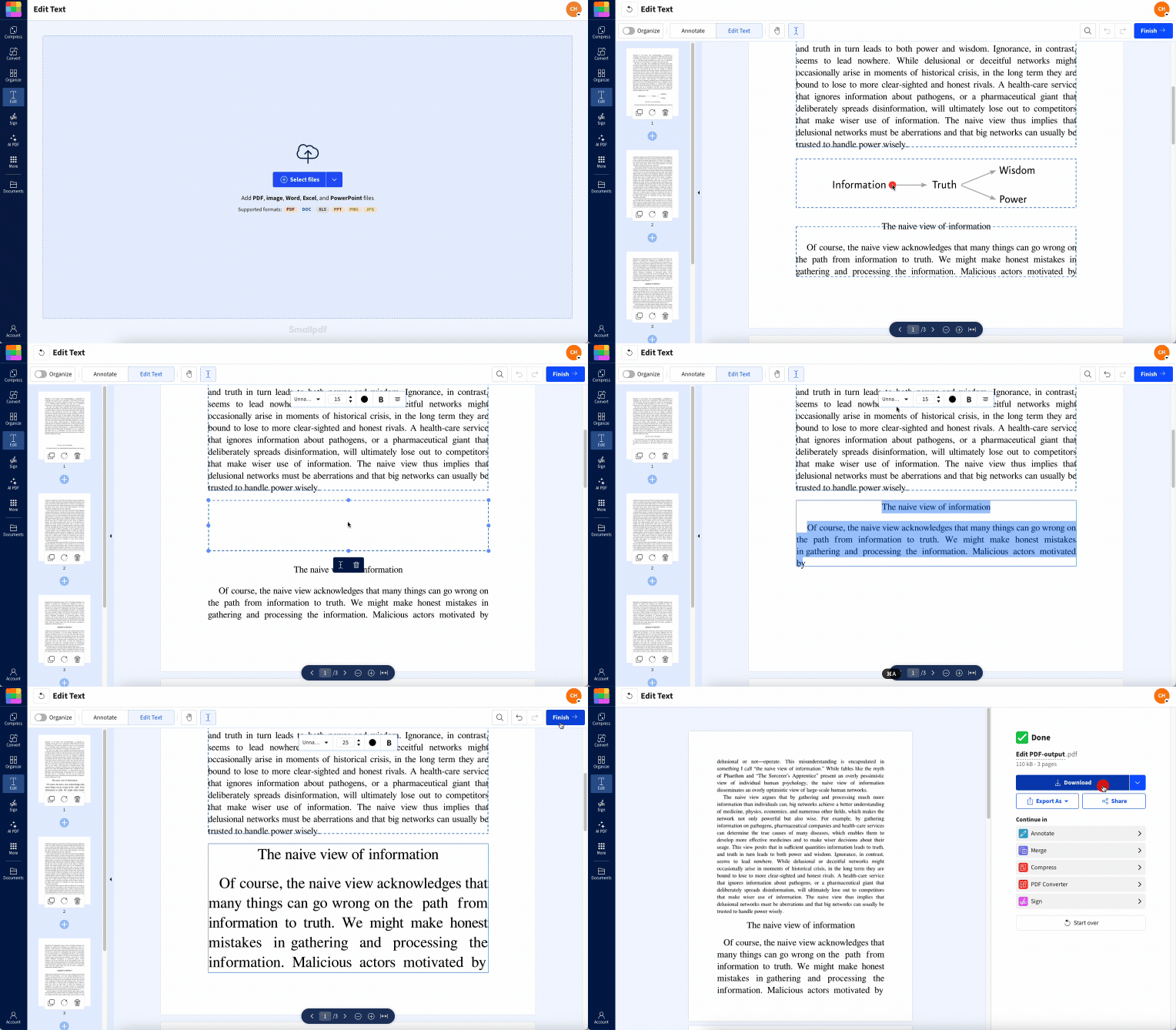
You might lose some interactive features when you move from EPUB to PDF, especially embedded media or complex navigation. After conversion, you can open the new file in Smallpdf Edit PDF to adjust layout details or add page numbers before sharing or printing.
Convert PDF to EPUB or MOBI
Moving from PDF to EPUB or MOBI is trickier because you are going from a fixed layout to a reflowable one. Tools such as Calibre and online converters can help, but complex layouts do not always convert cleanly.
You may see issues with:
Multi-column pages
Tables and diagrams
Text that was originally baked into images
For best results, start with a clear, well-structured PDF, then convert and review the output in your e-reader app.
You can use Smallpdf PDF to Word to create an editable version, fix headings and structure, re-export to PDF, and only then run the PDF through an EPUB converter.
Optimize Your PDFs for Better Reading
If you decide that PDF is the right format for your e-book or document, Smallpdf can help you make it easier to share and read.
You can convert drafts from Word or PowerPoint with PDF Converter, trim large files with Compress PDF, and clean up layouts or remove distractions with Edit PDF.
Start your free trial to explore these features and keep your PDFs readable on any screen, while still looking professional in print.
Convert Your PDF for Free
Frequently Asked Questions
Which is better for reading on a phone, PDF or EPUB?
EPUB is usually better for phones because the text reflows to fit the screen. You can change font size, switch themes, and read comfortably without zooming. PDFs can work for short documents, but long books often require constant panning and zooming.Is PDF or EPUB better for textbooks and study materials?
For visual-heavy textbooks, PDF is usually the better choice. It keeps charts, diagrams, and equations exactly where they belong on each page. EPUB works for text-heavy study guides, but complex layouts may shift or lose their structure.Is PDF more secure than EPUB?
PDF has mature security options such as password protection and digital signatures. EPUB files can be wrapped in DRM by stores or platforms, but that is not part of the core format. With PDF, you stay in control of who can open, copy, or print the file.Can I switch from PDF to EPUB without losing formatting?
You can convert from PDF to EPUB, but some formatting changes are almost guaranteed. Fixed layouts, multi-column pages, and image-heavy designs often need manual clean-up after conversion. A good workflow is to tidy your PDF first, then convert and review the e-book on a real reading device.Will EPUB and PDF both work on my Kindle?
Most modern Kindles can handle both EPUB (often via “Send to Kindle”) and PDF. EPUB will usually feel more natural for long reading, while PDF can work for reference pages, forms, or documents you plan to print. Optimizing PDFs with Compress PDF can also help them open faster on Kindle.Which format usually gives smaller file sizes, PDF or EPUB?
For plain-text books, EPUB is often smaller because it behaves like a compressed web package. PDF file sizes depend heavily on images, fonts, and resolution. When a PDF becomes too heavy, you can use Compress PDF to shrink it for easier sharing and downloads.Prepare share-ready ebooks on Smallpdf Pro