How To Save a Picture as PDF on an iPhone
Need to save a picture as a PDF on your iPhone? Do it in seconds with built-in apps, the Smallpdf mobile app, or an online converter. Free and secure.
More on Image Conversion Tools & Guides
More on JPG to PDF
More on PDF to JPG
Got a picture on your iPhone you need to share or store securely? Maybe it’s a photo of a receipt, an ID, a signed form, or a document you just scanned.
Whatever the reason, learning how to save a picture as a PDF on an iPhone makes it easier to send, print, and archive important files. It’s quick once you know your options. And you won’t need to pay or install anything. Below, we’ll cover four easy methods you can use right now.
Quick Steps to Save a Picture as a PDF on iPhone
Tip: You can also use the Files app, the Smallpdf mobile app, or an online converter if you need batch conversion or extra features.
Want to Save a Picture as a PDF With Ease?
How to Convert an iPhone Picture to PDF: 4 Quick Methods
Each method is simple, but one may be better depending on how often you do this and what level of control you want.
You might need to save a picture as a PDF for:
Receipts or proof of purchase
ID cards and passports
Signed forms or contracts
Handwritten notes or class materials
Photos you want to archive or print clearly
With that in mind, here are four quick ways to convert or save a picture as a PDF on your iPhone.
1: Use the Files App (Create PDF)
The Photos and Files apps on your iPhone allow you to convert images to PDFs without downloading anything.
Here’s how:
Open the Photos app and select your image.
Tap the Share icon at the bottom left.
Scroll down and tap “Save to Files.”
Choose a folder and hit “Save.”
Open the Files app and locate your saved image.
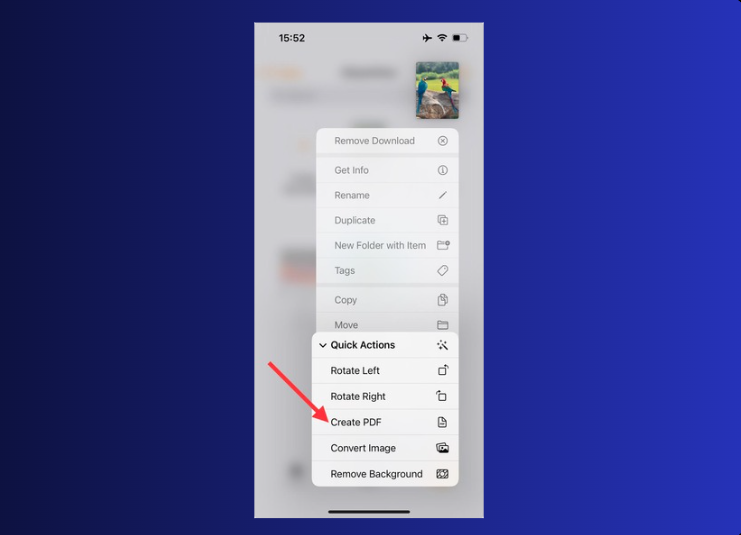
Press and hold the file, tap “Quick Actions”, then select “Create PDF.”
A new PDF file will appear in the same folder. You can then rename it, move it, or share it as needed.
Why use this method?
It’s great for one-time use. There’s nothing to install, and you don’t need an internet connection. But it takes several steps, and you can only convert one image at a time.
2. Use the Photos App “Print” Option
This is probably the fastest built-in method for converting a single image to PDF on your iPhone.
Here’s how:
Open the Photos app and select your image.
Tap the Share icon, then tap “Print.”
On the print preview screen, pinch outwards on the image with two fingers to zoom in. This creates a PDF preview.
Tap the Share icon again, this time on the PDF preview screen.
Select “Save to Files” and choose a location to save your new PDF document.
Why use this method?
It’s the quickest native option and requires fewer steps than the Files app method. Perfect when you need a PDF right now and don’t want to navigate through multiple apps.
3. Use the Smallpdf Mobile App
If you often work with PDFs on your iPhone, using the Smallpdf Mobile App saves you time and offers you multiple features.
Here’s how to convert pictures to PDF in the app:
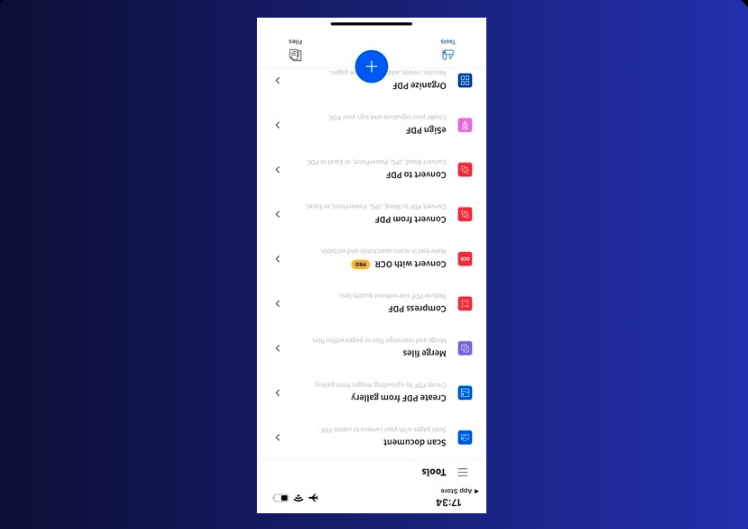
Tap the + icon or “Create PDF from gallery.”
Select one or more photos from your Camera Roll.
Rearrange, rotate, or crop them if needed.
Tap “Finish” to generate your PDF.
Save, rename, share, or upload to cloud storage.
You can also sign documents, add text, or compress the final PDF—all from your phone.
Why use this method?
This method is faster, cleaner, and supports batch conversion. It’s perfect for students, professionals, or anyone managing multiple PDFs from their iPhone.
The app is free to use for one task per day, or you can upgrade to Pro for unlimited access and advanced features like OCR.
4. Convert Online Without Installing an App
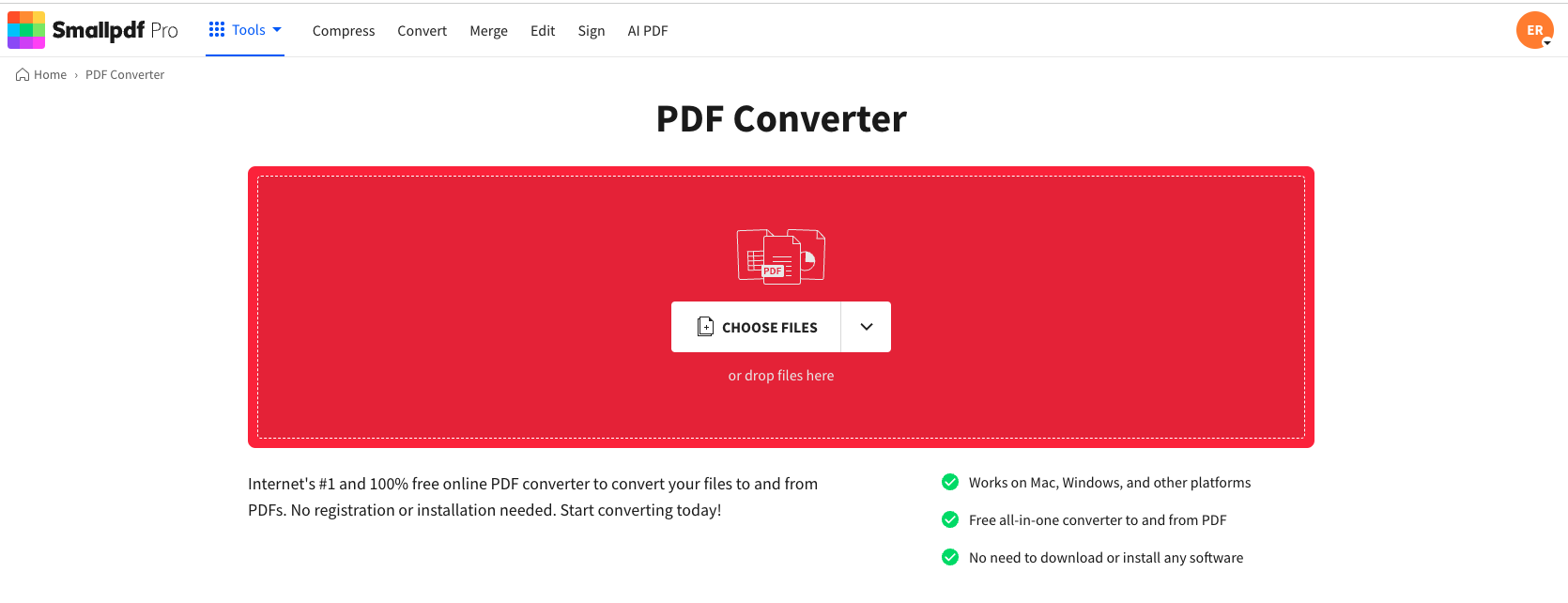
Don’t want to install anything? You can convert images straight from Safari (or any browser) using PDF Converter.
Here’s how:
Open PDF Converter in your iPhone browser.
2. Upload your image from your photo library or cloud storage.
3. Choose Image to PDF from the converter options.
4. Customize page size, orientation, and margins if needed.
5. Tap Convert and wait a few seconds.
6. Download your new PDF or save it to Drive, Dropbox, or iCloud.
No app. No signup. Just fast conversion.
Why use this method?
It’s perfect for one-time tasks or when you’re using someone else’s device. And it works with JPG, PNG, BMP, and TIFF formats.
Combine Multiple iPhone Images Into a Single PDF
Yes. All four methods above support multi-image conversion, but here’s how each one handles multiple images:
Files app: Select multiple images in Photos before tapping Share, then follow the same “Save to Files” process,
Print method: Select multiple images in Photos, then use the “Print” option to create a multi-page PDF.
Smallpdf app: Choose several pictures at once during the selection step for batch conversion.
Online converter: Drag multiple files into the converter or select them all at once.
Each image will be added as a separate page in your final PDF.
Want a single-page PDF instead? Combine images into one collage or scan first, then convert that file to PDF.
Compare the 4 Picture-to-PDF Methods on iPhone
If you’re unsure which method to use, here’s a quick rundown of how they compare:
Files App: Best for one-off conversions
Works completely offline with no installs. Ideal when you only need to convert one image at a time.
Pros: No internet required, built-in
Cons: Multi-image handling is slower
Photos App (Print Option): Fastest single-photo method
Great for quick results when you just need to share or submit a single image as a PDF.
Pros: Instant, minimal steps
Cons: Limited control over page setup
Smallpdf Mobile App: Most powerful option
Perfect for frequent use or batch conversions. You can reorder, crop, or sign documents in the same app.
Pros: Batch support, editing tools, OCR available with Pro
Cons: Requires app install. Free for one task per day
Online PDF Converter: Most flexible on any device
Converts from Safari or any browser, supports multiple file types (JPG, PNG, BMP, HEIC).
Pros: No install or sign-up needed, quick results anywhere
Cons: Needs an internet connection
Fix Common iPhone Picture-to-PDF Issues
Here are some common issues people encounter when converting on an iPhone.
My Converted PDF is Too Large
Use Compress PDF to reduce file size after conversion.
Avoid sending full-resolution photos. Screenshots and scans are lighter.
If quality allows, choose “Medium” or “Basic” compression for faster uploads.
The Image Quality Looks Blurry
Make sure you’re starting with a clear photo. A PDF can’t fix a blurry source.
If the image came from the camera, retake it in good lighting.
Avoid repeated compressions, each one reduces quality slightly.
Can’t Find the Converted File
Open the Files app and check the Recents tab.
If it’s missing, search for “.pdf” or the file name.
For browser conversions, look in Downloads or iCloud Drive.
PDF Won’t Open or Shows a Blank Page
Try reopening it in the Files app or re-downloading it.
On older devices, ensure iOS is updated. Outdated versions can misread PDFs.
If it still fails, open the file in Safari or a PDF Reader.
HEIC Photos Won’t Convert Correctly
Some older tools can’t read Apple’s HEIC format.
Use HEIC to PDF before converting, or share the image as a JPG first.
FAQs: Converting iPhone Pictures to PDF
Is there a built-in PDF converter on the iPhone?
Yes, the iPhone has two built-in methods for converting pictures to PDF. You can use the Files app’s “Create PDF” feature through Quick Actions or use the Photos app’s Print option with the pinch-to-zoom gesture to create a PDF preview.How do I create a PDF on my iPhone?
You have four main options: use the Files app’s Quick Actions menu, use the Photos app’s Print feature, download the Smallpdf mobile app, or use our online converter in Safari. All methods are free and work with most image formats.Which image formats can I convert to PDF on iPhone?
You can convert HEIC (iPhone’s default format), JPG, PNG, TIFF, and BMP images to PDF. If you need to convert HEIC files specifically, try our HEIC to PDF converter for the best results.Can I combine multiple images into one PDF?
Yes! All four methods support multi-image conversion. Simply select multiple photos in the Photos app before sharing or upload multiple files at once in the Smallpdf app or online converter. Each image becomes a separate page in your PDF.Is Smallpdf secure for personal photos?
Absolutely. Files are encrypted during upload and automatically deleted after processing. Your privacy is protected with ISO 27001 certification and GDPR compliance, plus TLS encryption for all data transfers.Turn complex statements into CSV in seconds with Pro