- Home
- ›
- ›How To Print a Large PDF File on Multiple Pages
How To Print a Large PDF File on Multiple Pages
Learn how to print large PDF files on multiple pages using poster mode. Prepare big PDFs with Smallpdf, and fix common large-format printing problems.
PDF Printing Tips & Guides
More on Edit PDF
PDF Reading Tools & Guides
When you try to print a poster, blueprint, or big chart from a PDF, your printer often only shows a small, scaled-down version.
The trick is using poster mode (also called tiled printing) and making sure your PDF is light enough for your printer to handle.
We’ll walk you through both parts: the print settings in your PDF reader and the prep steps you can handle with Smallpdf.
Quick-Start Checklist: Print Large PDF on Multiple Pages
How to Print a Large PDF on Multiple Pages (Step-by-Step)
Poster mode splits one large PDF page across many sheets of paper that you tape together. It is ideal for posters, floor plans, large tables, and technical drawings.
Step 1: Compress Your Large PDF Before Printing
First, use Smallpdf to organize or compress your large PDF, then download the optimized PDF and open it in your desktop reader.
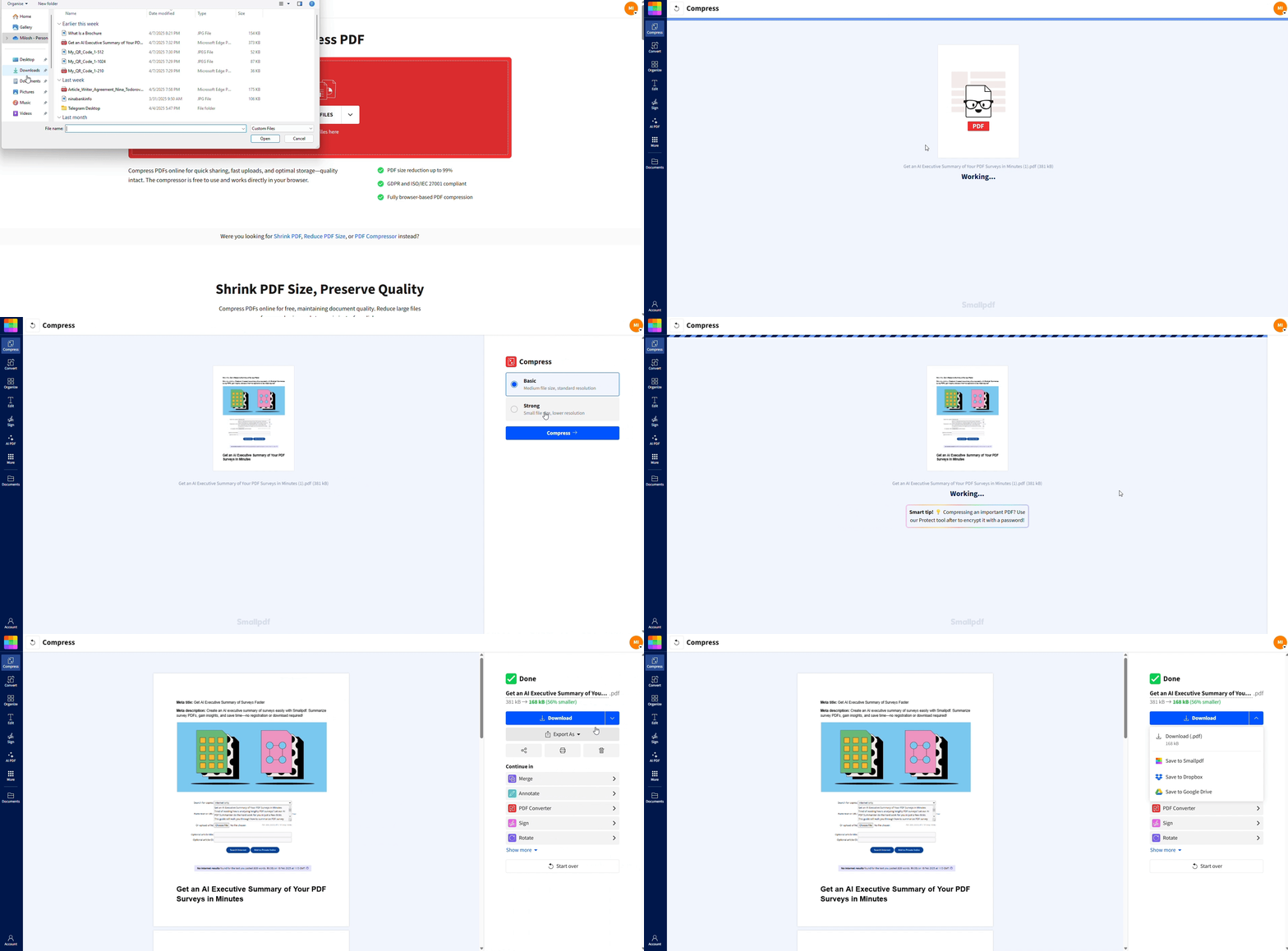
Then, open your large PDF in a reader that supports poster printing.
Step 2: Open the Print Settings
Click “File” > “Print” to open the print dialog. Make sure you select the correct printer and paper size (for example, A4 or Letter) before adjusting poster options.
Step 3: Select Poster Mode
In the “Page Sizing & Handling” section, choose “Poster” instead of the default setting such as “Fit” or “Actual size.” This tells the reader to tile the large page across multiple sheets.
Step 4: Adjust Tile Scale
Use “Tile Scale” to control how big your final print should be:
100% keeps the original size
200% doubles the size
400% creates a much larger print across more pages
Higher values create a bigger final poster but also increase the number of pages you need to print and assemble.
Step 5: Set Overlap and Cut Marks
Turn on “Overlap” and “Cut marks” if they are available:
Set overlap to around 2–3 mm so neighboring pages share a small area for taping.
Enable cut marks so you can trim the edges more accurately and match seams.
These settings make assembly much easier, especially for larger posters.
Step 6: Review the Print Preview
Look at the preview pane to see how many sheets you will print and how the pages line up. If the layout feels too large or uses too much paper, reduce the tile scale. If details look too small, increase the scale.
Step 7: Print and Assemble
Click “Print” to send the job to your printer. Once the pages are printed, trim along the cut marks, overlap the edges, and tape or glue the sheets together in order.
If you’re printing multi-section projects, add small pencil labels on the back of each page to assemble the layout faster.
What Is Poster or Tiled Printing?
Poster printing (tiled printing) takes one big PDF page and splits it into smaller pieces that fit on standard printer paper. When you tape those pieces together, you get a larger version of the original page.
You might use poster printing for:
Marketing posters and banners
Architectural drawings and floor plans
Large presentation diagrams and charts
Engineering schematics
Art prints and large photo layouts
Instead of sending the file to a print shop immediately, you can test scale and layout on your own printer first.
Essential Poster Print Settings
Getting your poster print settings right makes all the difference between a smooth assembly and a frustrating puzzle.
Here’s what each setting does:
1. Tile Scale
This controls how much larger your final print will be compared to the original. A 200% tile scale doubles the size, while a 400% makes it four times larger.
Keep in mind: higher percentages mean more pages to print and assemble, but also a bigger final result.
2. Overlap
Overlap creates a small border where adjacent pages share content, making it easier to align and tape them together. We recommend 2-3mm for most projects.
Without overlap, you’d need perfect alignment, and let’s be honest, that’s pretty tough to achieve by hand!
3. Cut Marks
These handy lines show you exactly where to trim each page for perfect alignment. Enable cut marks if you want professional-looking results. They’re especially useful for marketing materials where precision matters.
4. Labels
Labels add the file name and page numbers to each sheet, which is a lifesaver when you’re dealing with dozens of pages. Trust us on this one—it prevents mix-ups during assembly.
Alternatives to Adobe Reader
If you do not have Adobe Acrobat installed, you still have options for printing large PDFs across multiple pages and preparing the document with Smallpdf.
Using Smallpdf to Prepare Large PDFs
Smallpdf focuses on getting your file ready for printing:
Use Compress PDF to reduce file size and avoid “file too large” errors.
Use Split PDF to separate big multi-page documents into sections if your printer struggles with long jobs.
Use Edit PDF to adjust small layout issues before printing.
After prep, download the optimized PDF and open it in a desktop reader that supports poster printing.
Online Tiling Tools
Services like PosteRazor let you upload a PDF and generate a new tiled version ready for printing. You can then open that tiled PDF in your usual viewer and print it without extra configuration.
Troubleshooting Common Issues
Large-format printing can run into a few common problems. Here is how to handle them.
1. Scaling Issues or Distortion
If the image looks stretched or parts are cut off:
Use “Actual size” or a specific “Custom scale” instead of automatic scaling.
Check that the original PDF page size matches what you expect; a distorted source file will not print accurately.
You can also open the file in Edit PDF to confirm the layout before printing.
2. File too Large or Printer Memory Errors
If your printer stops responding or shows memory errors for large PDFs:
Compress the file with Compress PDF to reduce image complexity.
Try printing in smaller chunks by using Split PDF to divide the file into sections.
Print a few tiles at a time instead of the entire poster in one job.
These steps help older or low-memory printers handle large documents more reliably.
3. Margins or Text Cut Off
If the edges of text or frames are missing after assembly:
Add a small bleed (around 0.125 inches) at design time to give trimming space.
Keep important text and logos inside a safe margin away from page edges.
Check that “Fit” or “Shrink oversized pages” is not cutting content unexpectedly.
You can adjust margins in your design software, then export a new PDF and run it through Smallpdf before printing again.
4. Printer not Responding or Freezing
If the printer hangs on large jobs:
Cancel the print job and restart both your printer and computer.
Update your printer driver to the latest version.
Try printing in grayscale instead of full color to reduce data load.
Use Split PDF to break the job into smaller sections and print each one separately.
This helps prevent long, complex PDFs from overwhelming your print queue.
Master Large Format Printing with Smallpdf
Once you understand poster mode and the key print settings, printing large PDFs across multiple pages becomes much more straightforward.
Smallpdf helps you prepare those files by compressing, splitting, and organizing them so your printer can handle the job smoothly.
When you are ready to move from draft to final print, we are here to keep your PDFs light, organized, and ready for any printer.
Start your free trial to access all Smallpdf tools and make poster printing simple.
FAQs: Printing Large PDF Files
How to print a PDF that is too big?
First, compress it with Compress PDF to reduce file size. Then open the PDF in a reader with poster mode and use “File” > “Print” > “Poster” to tile the page across multiple sheets instead of shrinking it down.How to print long size in PDF?
If your PDF uses a long custom page size, use poster or tiled printing to split that page across multiple sheets. Adjust tile scale so the printed length matches your target size, then assemble and trim the pages.How to print a large size PDF in multiple pages?
Open the PDF in your PDF reader with poster mode. In “File” > “Print,” choose “Poster,” set tile scale, overlap, and cut marks, preview the layout, and then print. Use Smallpdf beforehand to compress or split very large files.How do I print only a portion of a large PDF?
In the print dialog, use “Current view” or a custom page range to print just one area or page. For more control, use Crop or Split PDF in your design software or Smallpdf first, then print only the cropped section.What should I do if a PDF size is too big for my printer?
Compress the PDF with Compress PDF, and if the issue persists, split the document into smaller parts using Split PDF. Printing in smaller segments reduces strain on your printer and avoids memory errors.How to cut a long PDF into pages?
Use Split PDF to break a long multi-page PDF into separate files or smaller ranges. You can then print each part separately, or adjust layout and margins before combining them again with Merge PDF.Compress and optimize large PDFs before printing with Smallpdf Pro