- Home
- ›
- ›Book Clubs in the Age of AI: What Counts as Reading Now?
Book Clubs in the Age of AI: What Counts as Reading Now?
A survey of 1,014 readers reveals how PDFs, audiobooks, and AI have rewritten the rules of the modern book club.
Book clubs are having a moment, and they look nothing like the paperback-and-wine-night stereotype. A new Smallpdf survey of 1,014 readers, including current and former book club members, shows how PDFs, audiobooks, group chats, and AI have crept into the way clubs read and meet. It also reveals how often the book itself gets skimmed, summarized, or skipped.
Key takeaways
More than 1 in 3 people (37%) say listening to the full audiobook does not count as reading the book.
A majority of book club attendees (58%) admit they've shown up without finishing the book, while 13% never started it.
Nearly 1 in 3 members (30%) have used either an AI tool or online recap to fake their way through a discussion.
For 43% of members, a book club is more about friendship than books, and just 29% say it is really about reading and discussing deeply.
Book club members are far more likely than people who've never joined to say reading is central to their social life (83% vs. 32%).
Mystery and thriller spark the best book club discussions, as named by 50% of book club members.
59% of current book club members say they read more now than they did before, compared to 32% of non-members.
The New Book Club Starter Pack
Print is far from dead, but the modern book club runs on a mix of formats and screens.
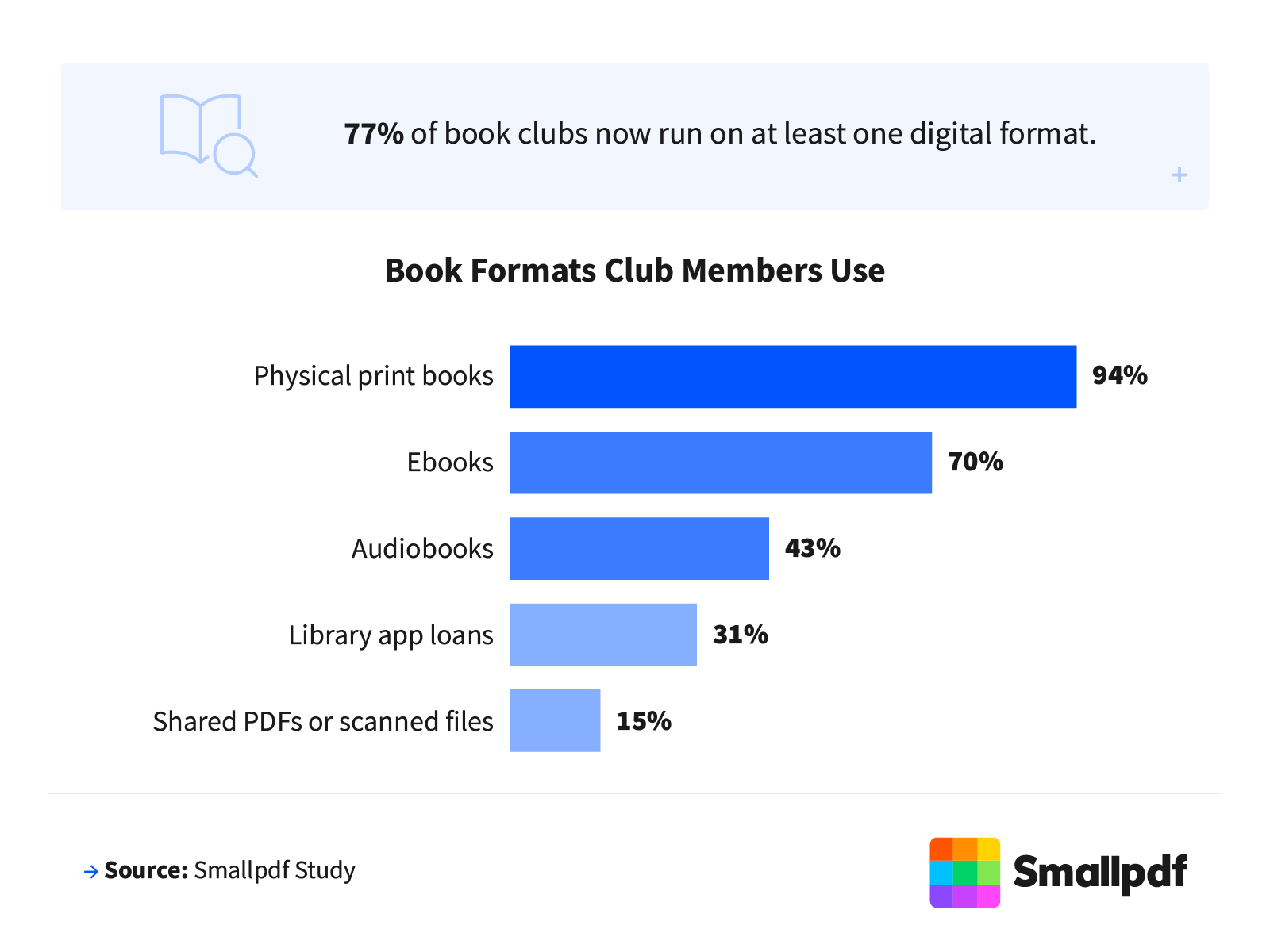
Here's the format mix members reported using:
More than three-quarters of clubs (77%) run on at least one digital format.
Physical print still tops every list at 94%, followed by ebooks (70%) and audiobooks (43%).
Library apps show up in 31% of clubs, and shared PDFs or scanned files in 15%.
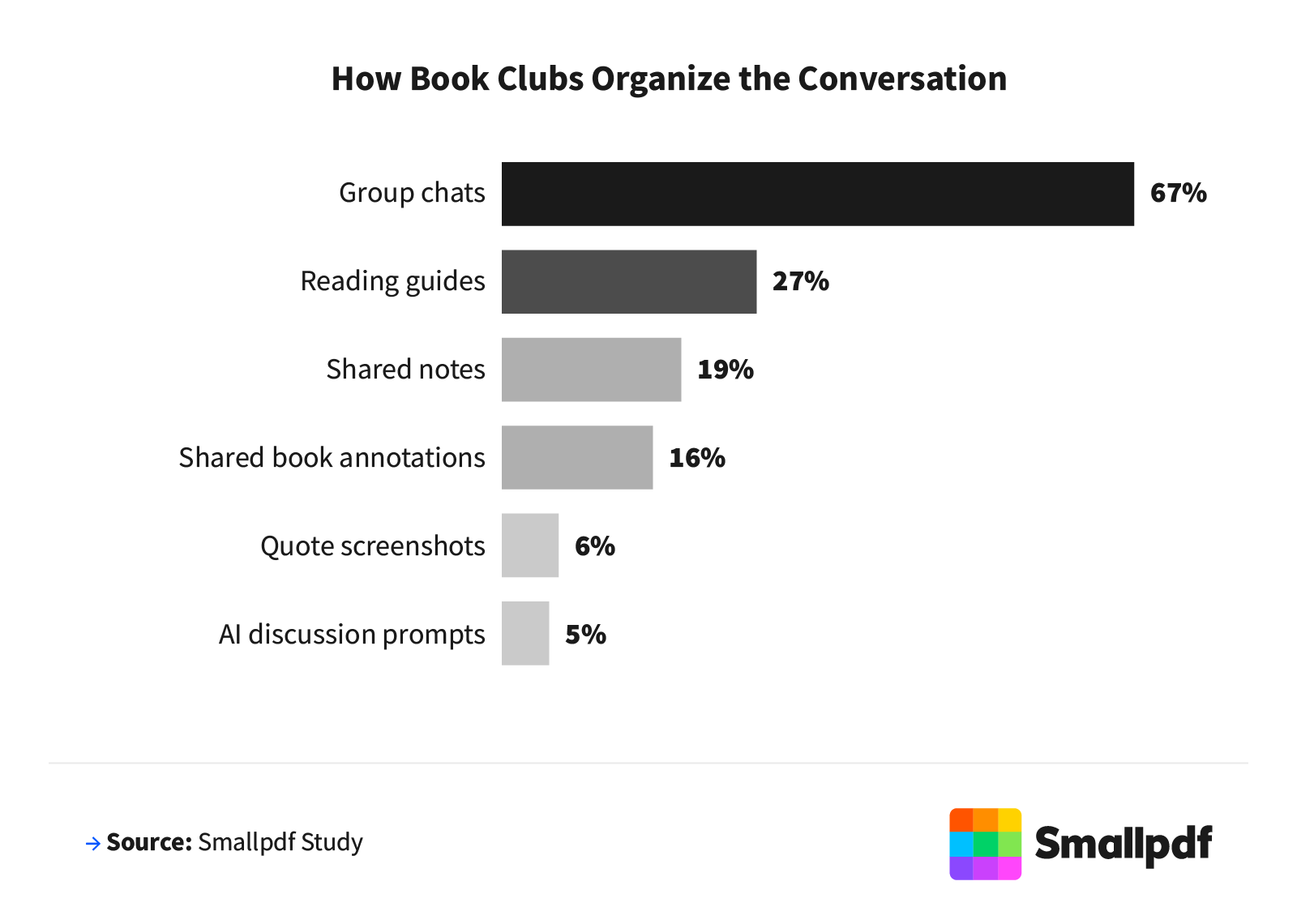
The tools that keep the conversation going stayed low-tech:
Group chats run the show at 67%, ahead of every reading or AI tool.
Reading guides (27%), shared notes (19%), and shared annotations (16%) fill in behind.
AI-generated discussion questions are a fringe habit at just 5%.
Among the clubs that tried AI questions, 87% liked them or didn't mind.
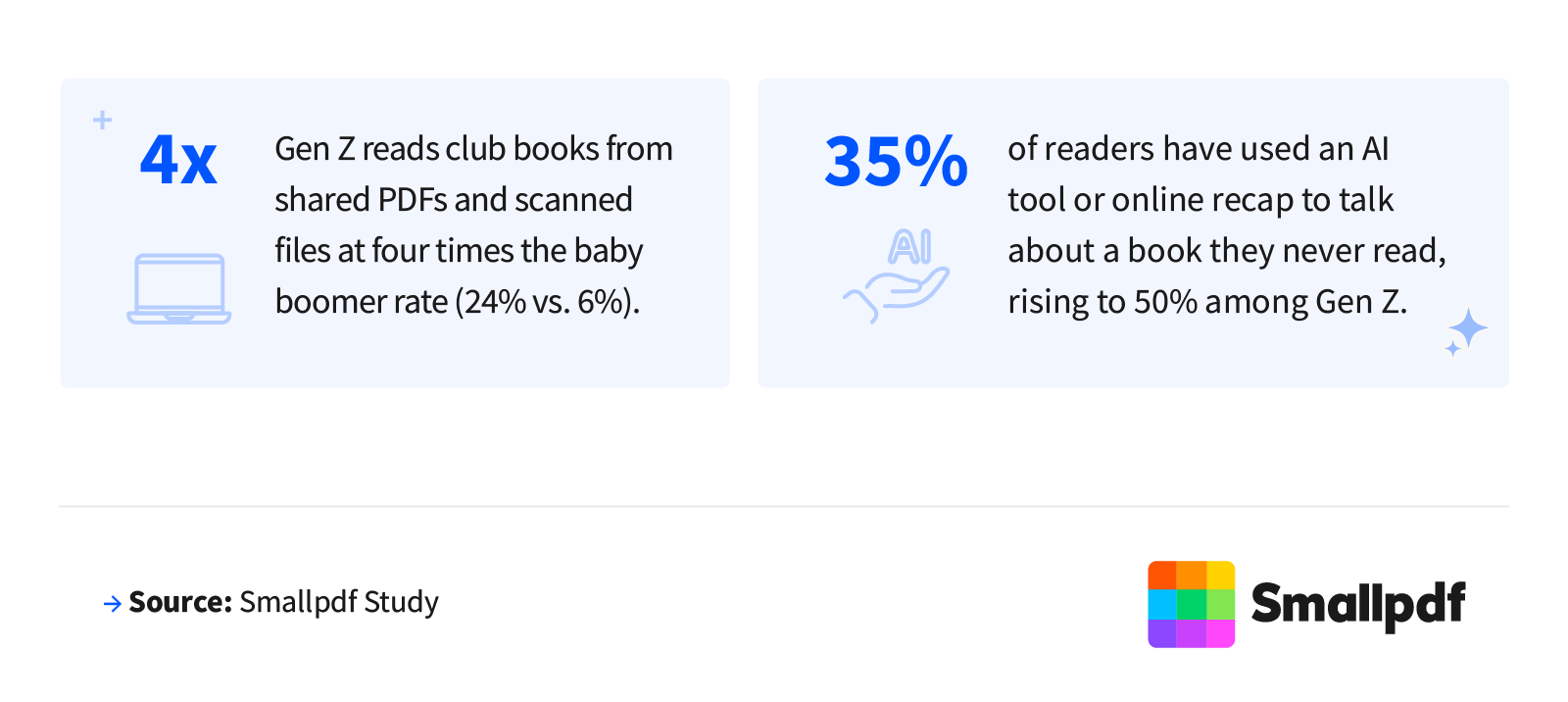
Who was in the club, and where it met, shifted the format mix:
Gen Z members are four times as likely as baby boomers to read from shared PDFs or scanned files (24% vs. 6%).
Virtual clubs are three times as likely as in-person ones to share a single digital file (21% vs. 7%), often merged into one PDF.
Urban clubs share PDFs and scanned files at more than twice the rate of suburban and rural ones (23% vs. 11%).
The Quiet Confession
Behind the tidy discussions, most members fessed up to a few behaviors.
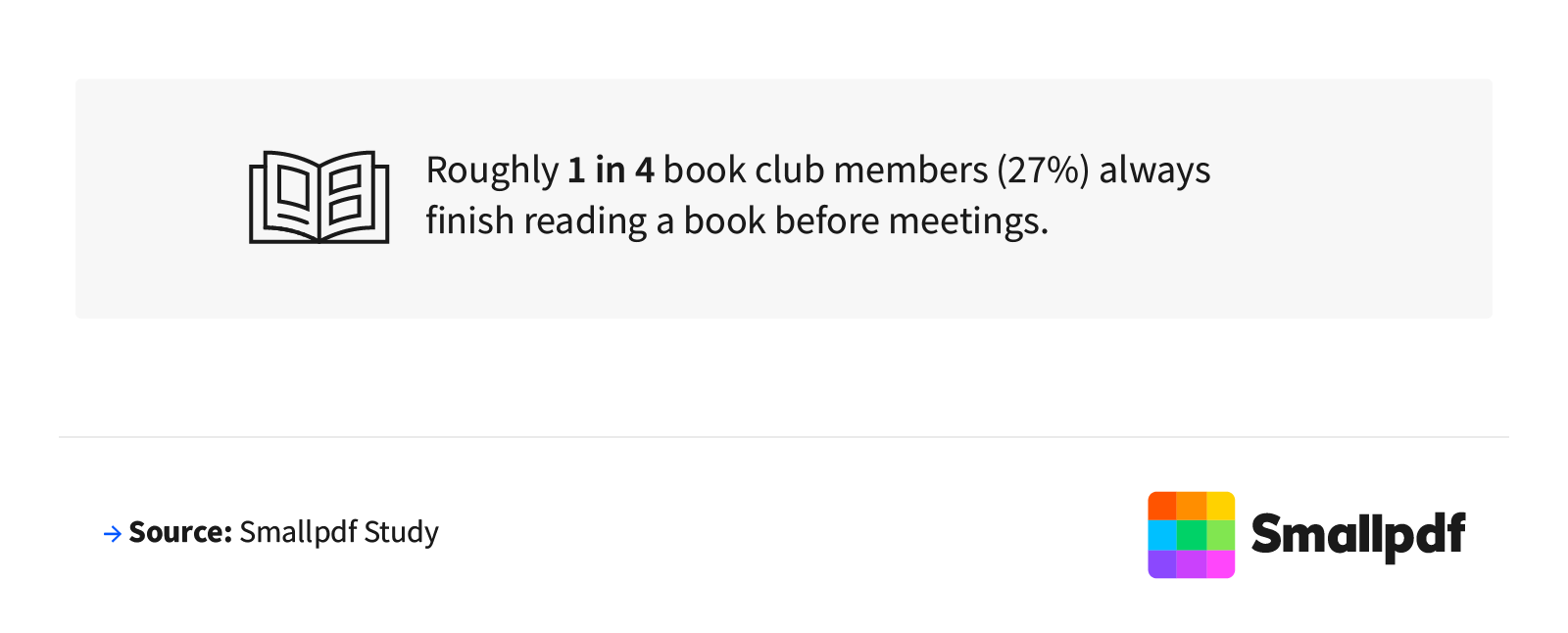
Finishing the book before the meeting turned out to be rare:
Only about 1 in 4 members (27%) always finish the book in time.
A majority (58%) have shown up to a meeting without finishing, and another 13% had never started.
Roughly 1 in 5 members (22%) have pretended to know more about a book than they actually did.
Across all readers, 47% admit to using a shortcut, whether a recap, an adaptation, or skimmed notes, to talk about a book they didn't fully read.
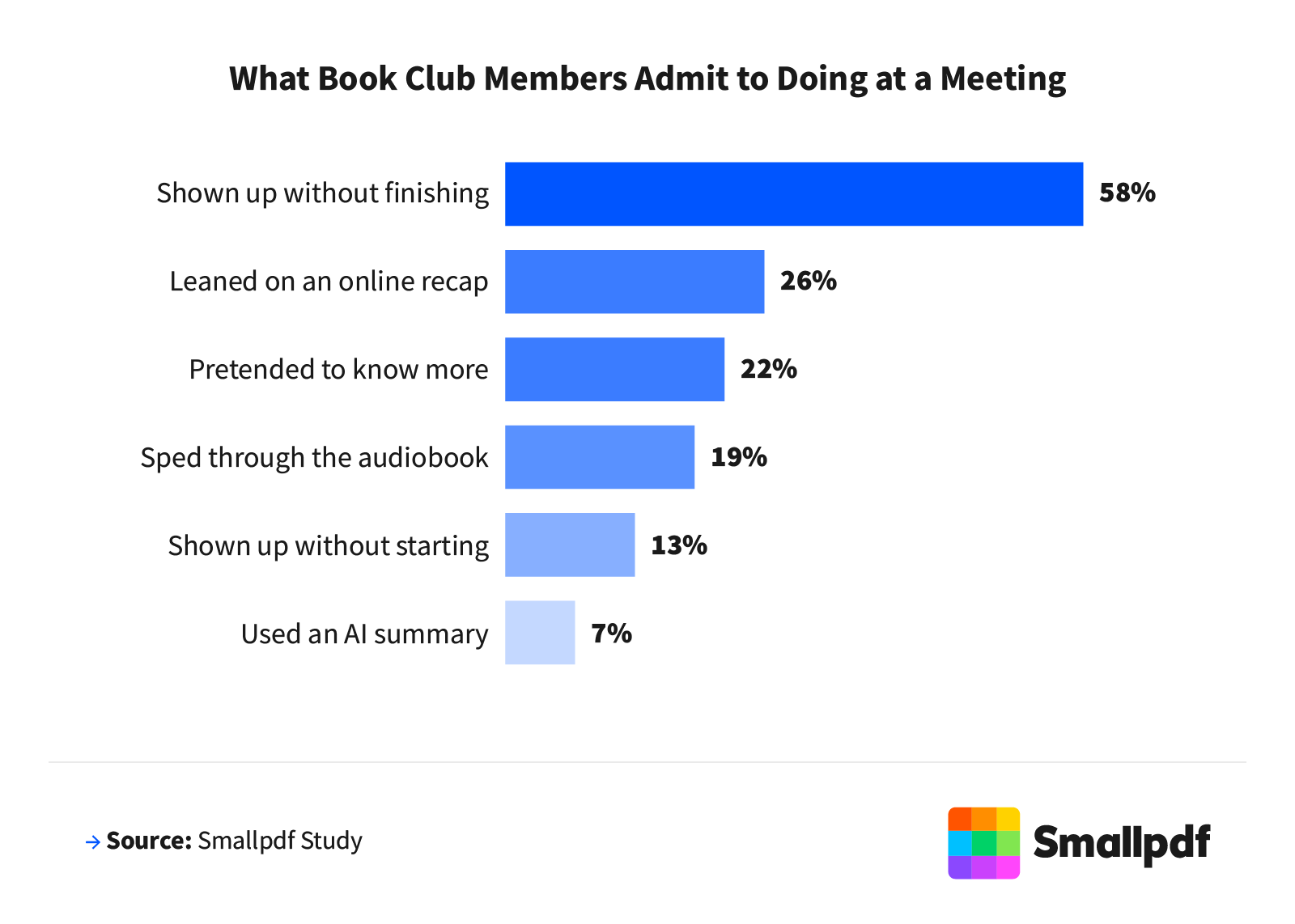
AI has started turning up in book clubs, too:
Nearly a third of members (30%) have used either an AI summary or online recap to get through a discussion they weren't ready for.
Some members (17%) have watched the movie or TV adaptation instead of reading.
Overall, 24% of readers have used an AI tool to help them read or discuss a book.
ChatGPT is the top AI tool for books, used by 18% of readers.
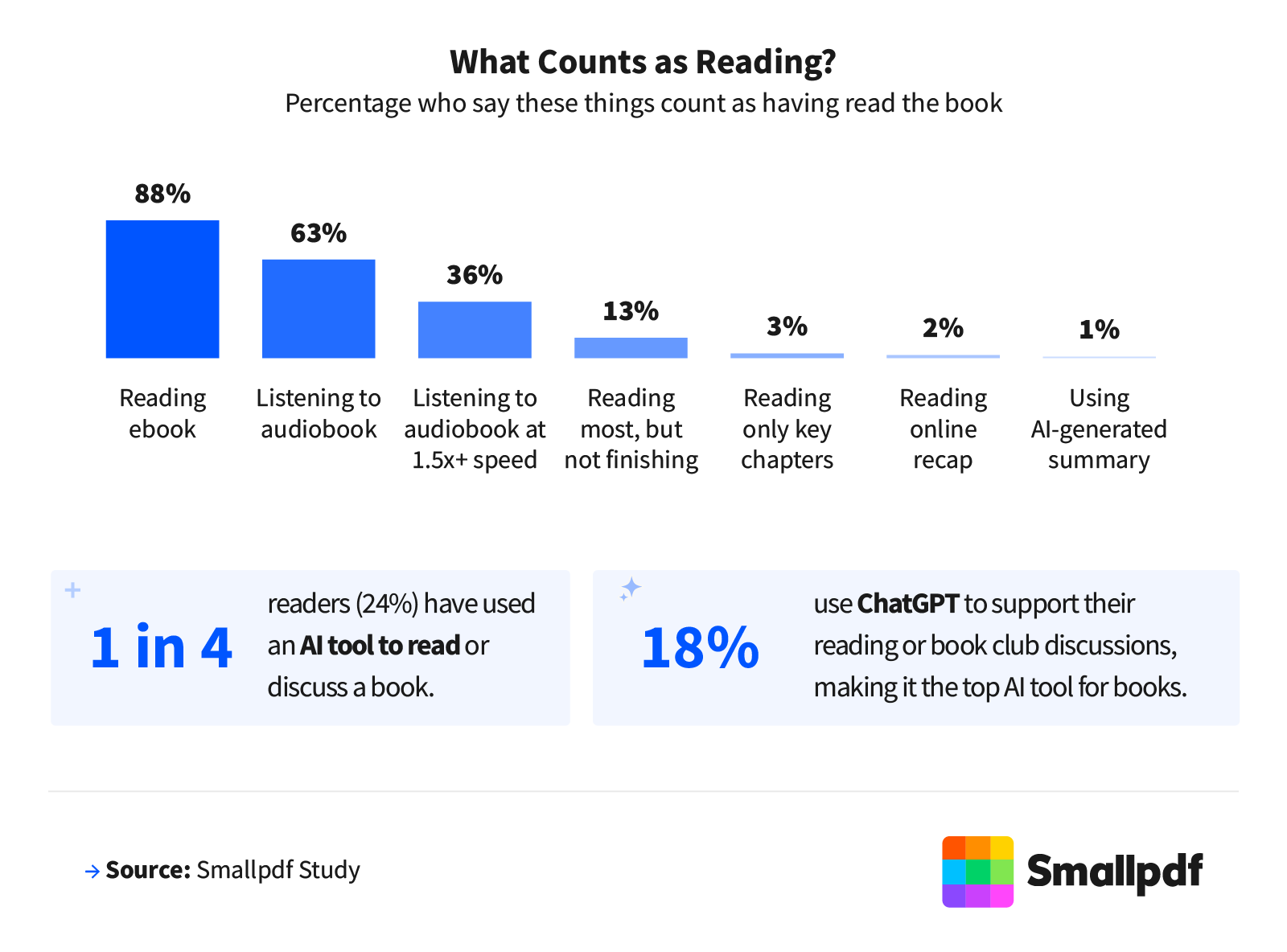
Readers couldn't agree on what counts as reading:
A full ebook satisfies 88% of people, and a full audiobook counts according to 63%.
More than 1 in 3 (37%) say a full audiobook doesn't count as reading at all.
Speed an audiobook past 1.5x and support drops to 36%.
AI recaps ranks at the bottom, and for good reason: they're quick, but leaning on one is a fast way to miss the book everyone came to talk about.
It Was Never Really About the Book
Ask members why they keep coming back, and the book is rarely the whole answer.
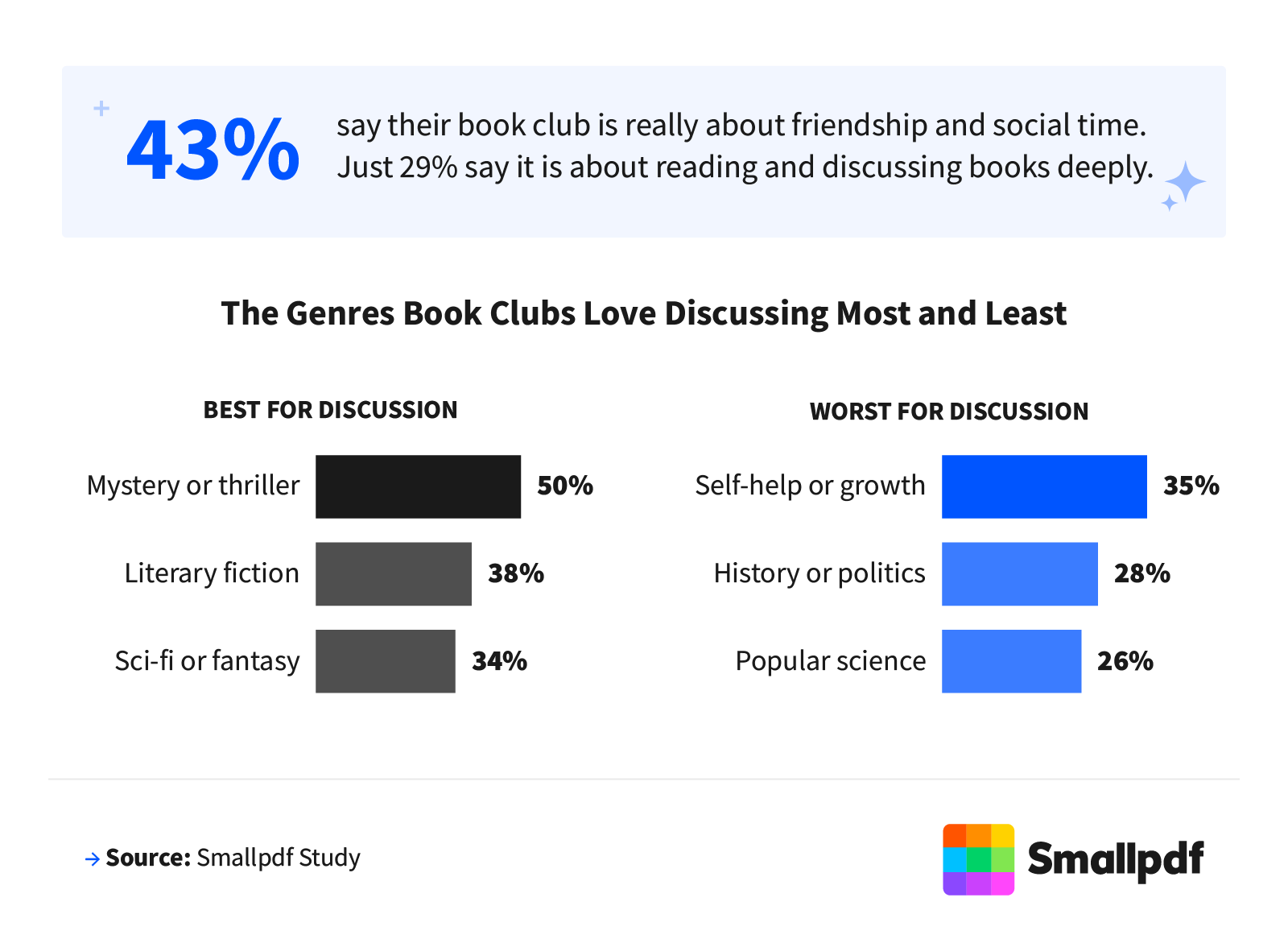
For most members, the draw of a book club is social first and literary second:
For 43% of members, the club is really about friendship and social time.
Just 29% say it's mainly about reading deeply.
The payoff shows up socially: 90% call their discussions genuinely engaging, and 71% feel close to their group.
When clubs fall apart, scheduling and attendance problems (55%) are the cause twice as often as fading interest (27%).
On the page, some genres carry the room while others empty it:
Book club members say mystery and thriller lead to the best discussions (50%), followed by literary fiction (38%).
Self-help falls flattest, with 35% calling it the worst genre for discussion.
Romance splits the room, rated both best and worst by an equal 29%, making it the most divisive genre among members.
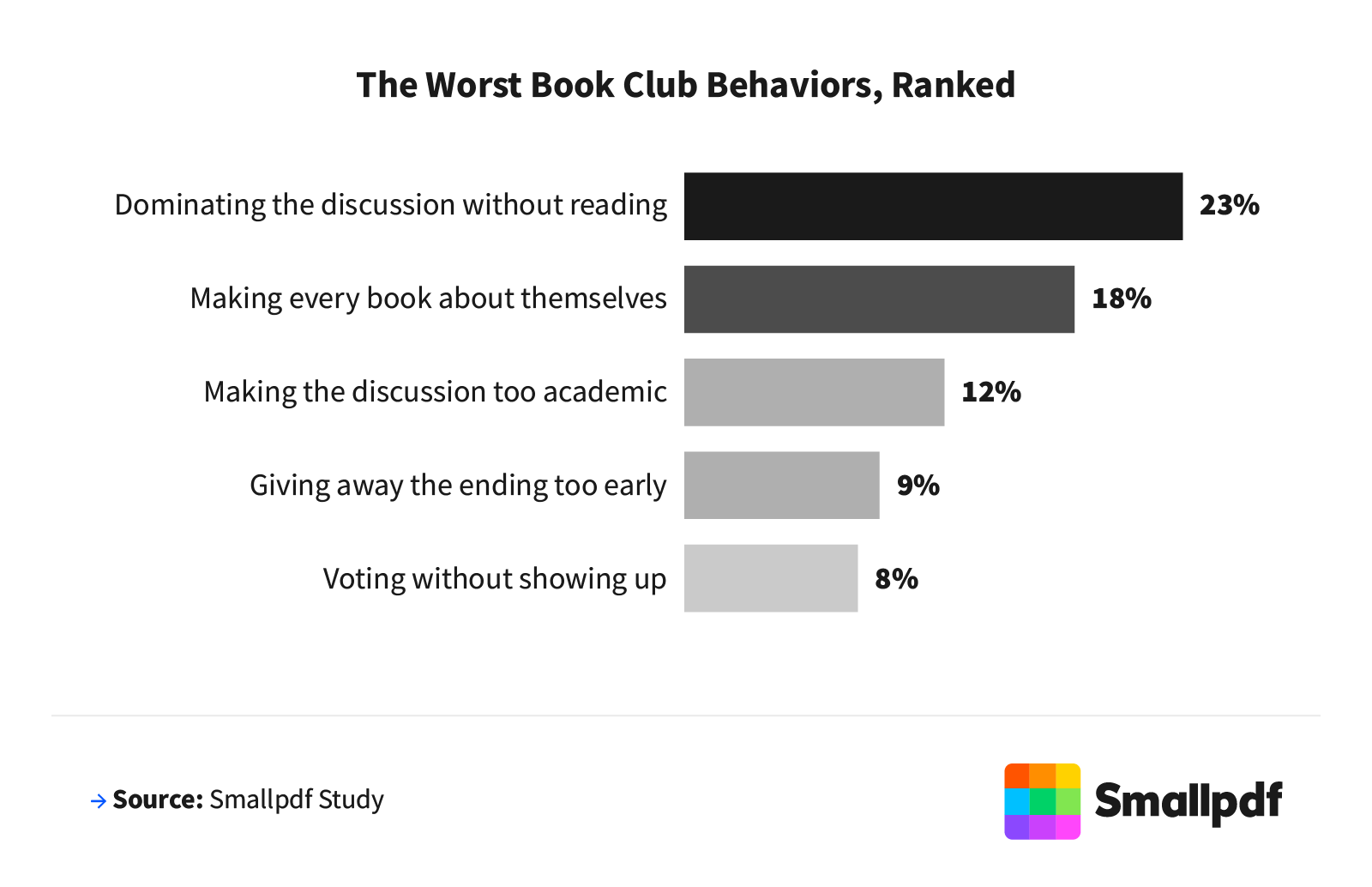
And every club has its villains. Members ranked the worst offenders:
The freeloader who doesn't read but dominates the discussion topped the list at 23%.
The member who makes every book about themselves came next at 18%.
Making the discussion too academic (12%), spoiling the ending (9%), and voting for a book without showing up for the discussion (8%) rounded out the list.
Membership also tracks with a bigger reading life:
Current members are far more likely than non-members to say they read more now than they used to (59% vs. 32%).
Members are 2.6 times as likely to say reading is central to their social life (83% vs. 32%).
And they read a wider variety of books (72% vs. 39%) and get through 1.8 times as many books a year on average (18 vs. 10).
What Modern Book Clubs Are Really Made Of
The paperback hasn't disappeared, but it now shares the table with ebooks, audiobooks, group chats, and the occasional AI recap. What keeps a club alive turns out to be the people more than the pages, from steady scheduling to the friends who show up. AI can fill a gap when you're behind, but the members who actually read still carry the best conversations.
Methodology
Smallpdf commissioned this study to understand how Americans read today and how book clubs have adapted to a landscape of ebooks, audiobooks, shared files, and AI tools. The survey was fielded through CloudResearch Connect and Prolific and completed by 1,014 U.S. adults. After collection, responses were cleaned to retain only complete records with a unique respondent ID.
Respondents were grouped by their relationship to book clubs. Of the 1,014 people surveyed, 263 were current book club members, 435 were former members, and 316 had never joined a club. Questions about club life, formats, tools, and discussion habits were asked only of current and former members, a base of 698. Questions about personal reading behavior, what counts as reading, and AI use were asked of all 1,014 respondents. Because questions carried different bases, each reported figure should be read against the group that answered it.
The sample skewed female at 70%, with 28% male, and the remainder non-binary or preferring not to say. By generation, the sample was 48% millennials (ages 30 to 45), 24% Gen X (ages 46 to 61), 18% Gen Z (ages 18 to 29), and 10% baby boomers (ages 62 and older). Age was collected as a number and recoded into these generational bands for all reporting.
Several questions allowed respondents to select more than one answer, so those percentages reflect the share of respondents choosing each option and can total more than 100%. For questions that asked for a number, such as books read in the past year or club size, averages were calculated both across all responses and with statistical outliers removed using the interquartile range method, which excludes values that fall more than 1.5 times the interquartile range below the first quartile or above the third.
Demographic differences are reported only for subgroups that represent at least 5% of respondents, so the non-binary and prefer-not-to-say groups are excluded from demographic callouts. All figures are rounded to the nearest whole number, and rounding may cause some totals to differ slightly from 100%.
Findings describe associations rather than proven cause and effect. Where the study compares book club members with non-members, differences reflect the groups as they are, and readers who are more social or more avid may be more likely to join a club in the first place.
About Smallpdf
Smallpdf is an easy-to-use online platform that helps people convert, compress, edit, merge, split, and sign PDFs in a few clicks. Whether you're combining a reading schedule, discussion prompts, and your own notes, Smallpdf turns a stack of separate files into one clean document you can share with the group.
Fair Use Statement
You are welcome to share the findings and visuals from this study for noncommercial purposes. Please link back to this page and an attribution to Smallpdf so readers can view the full research and the authors receive proper credit.