- Home
- ›
- ›The Hidden PDF Tax on the American Workforce
The Hidden PDF Tax on the American Workforce
Learn how PDF tasks impact productivity, from lost hours to workflow delays, and how AI tools are helping professionals work more efficiently.
Smallpdf surveyed 1,005 U.S. professionals about how PDF-related work affects their productivity, workflows, and tool usage. We found that document challenges are quietly draining time, money, and momentum across teams.
Key takeaways
The average U.S. worker loses 182 hours a year to PDF tasks, the equivalent of $6,803 in lost productivity.
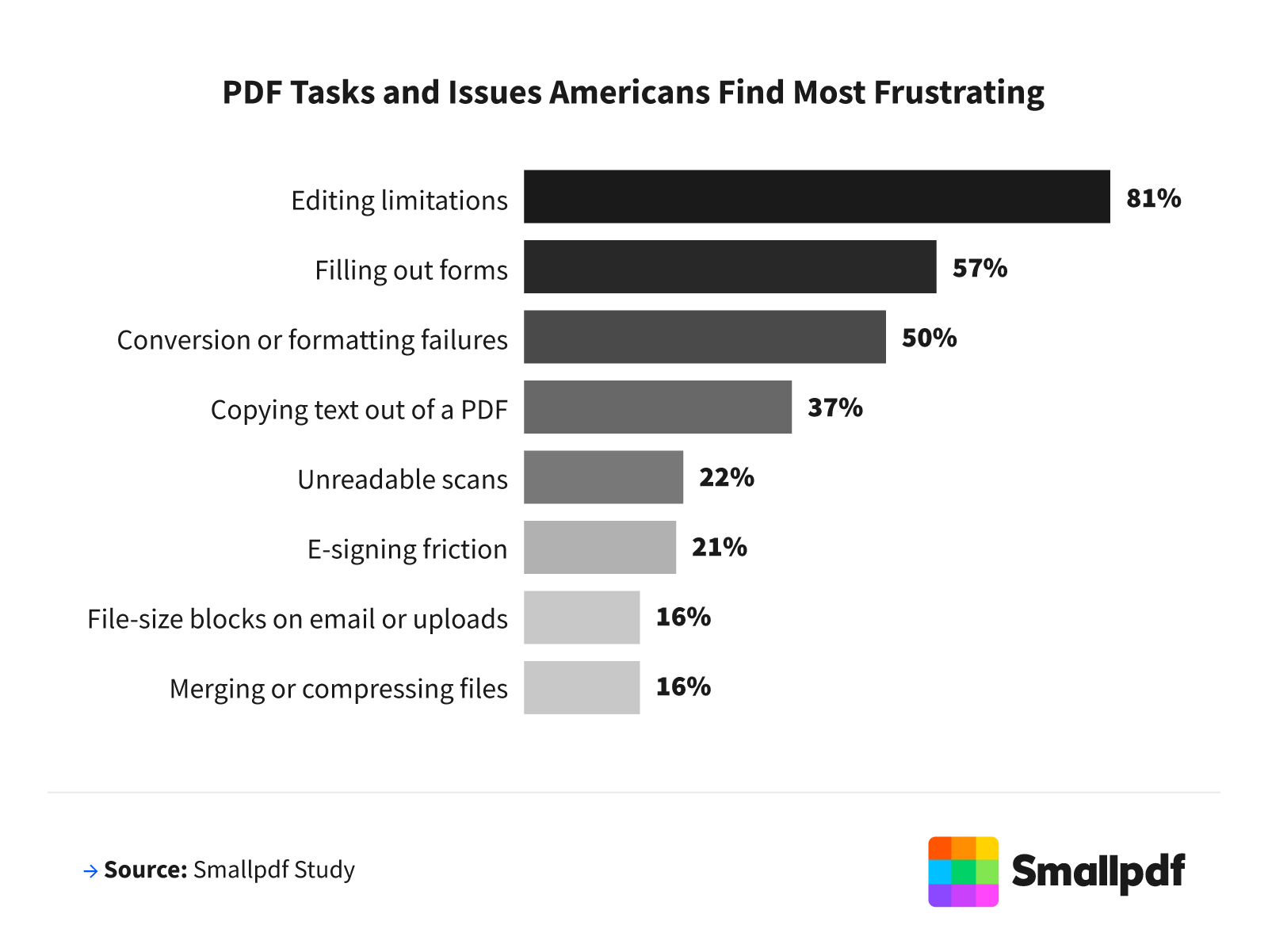
4 in 5 U.S. workers (81%) rank editing limitations among their top 3 most frustrating PDF issues.
42% of U.S. workers have printed a PDF, edited it by hand, and scanned it back in because editing the digital version was too difficult.
Just under half of U.S. workers (44%) currently use AI tools to help with PDF tasks.
How PDF Friction Slows Down Workflows
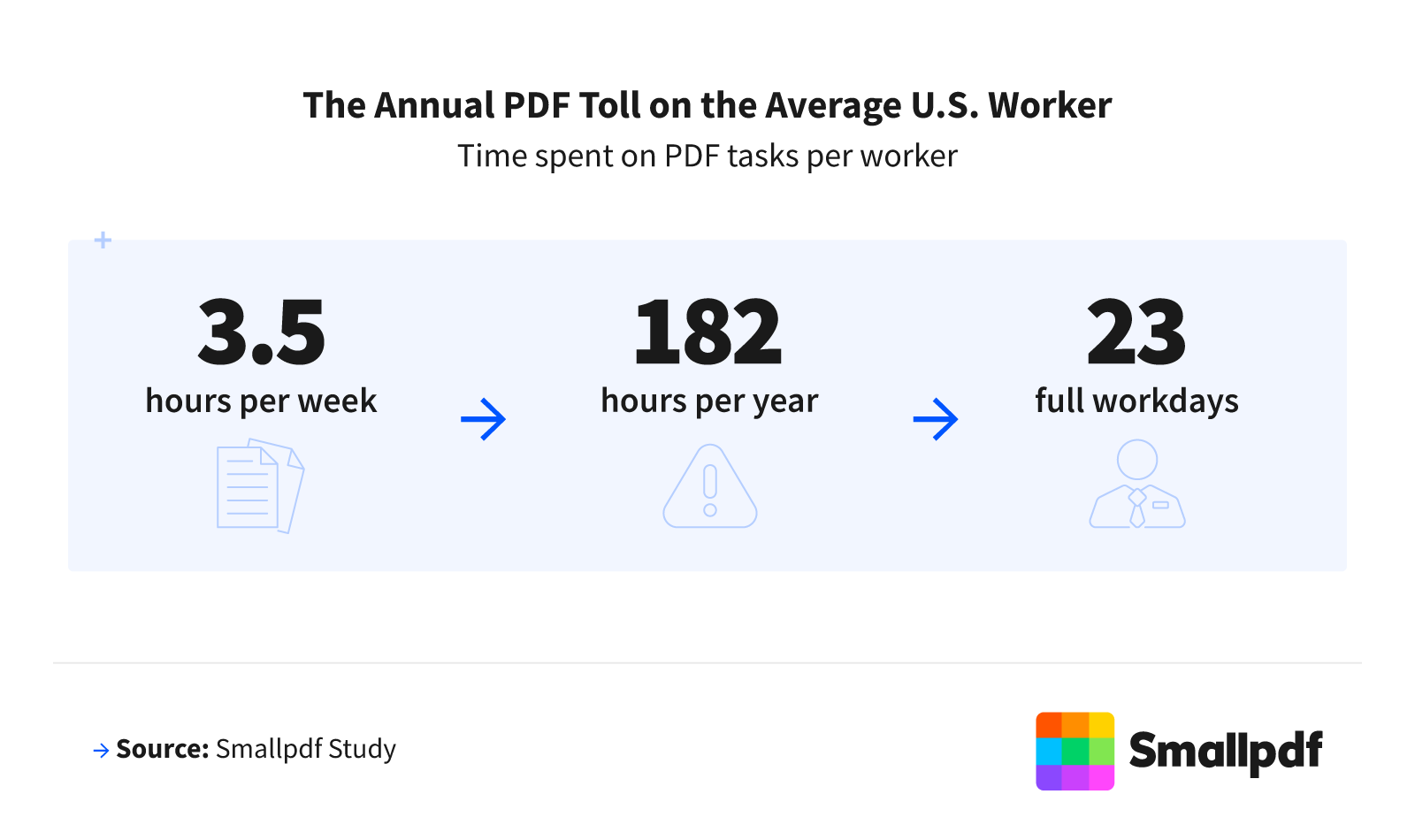
The average U.S. worker loses 182 hours a year to PDF tasks, the equivalent of $6,803 in lost productivity.
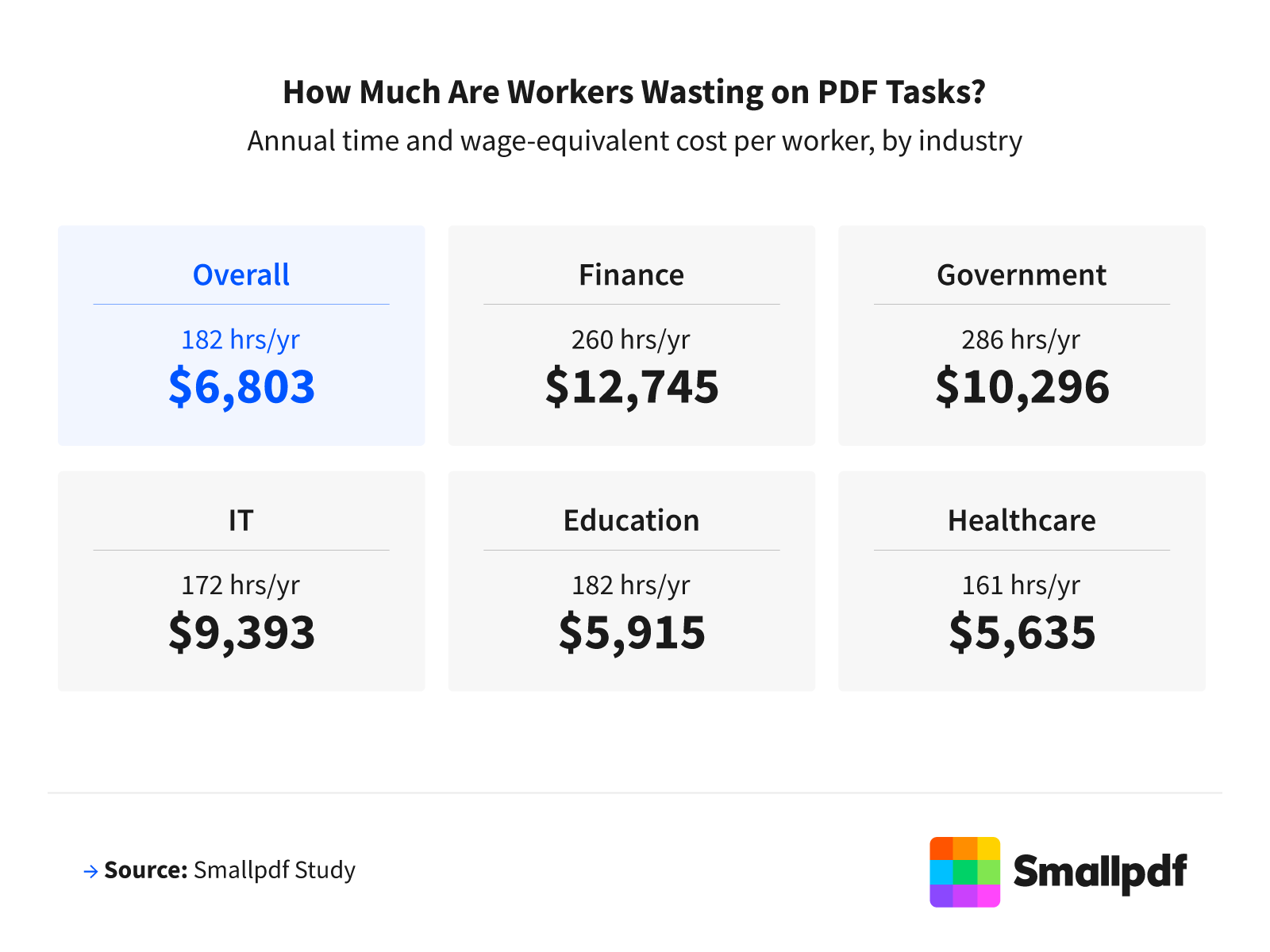
Finance workers waste the most money on PDF tasks, losing 260 hours and $12,745 per worker per year. That's nearly double the national average.
Government workers waste the most time, with 286 hours per year per worker, equivalent to $10,296 in lost productivity at the public sector mean wage.
IT workers lose only 172 hours per year, but at the highest hourly wage in the study, that translates to $9,393 in lost productivity per worker.
Education workers spend 182 hours a year on PDF tasks, costing roughly $5,915 per worker.
Healthcare workers lose 161 hours per year, costing roughly $5,635 per worker.
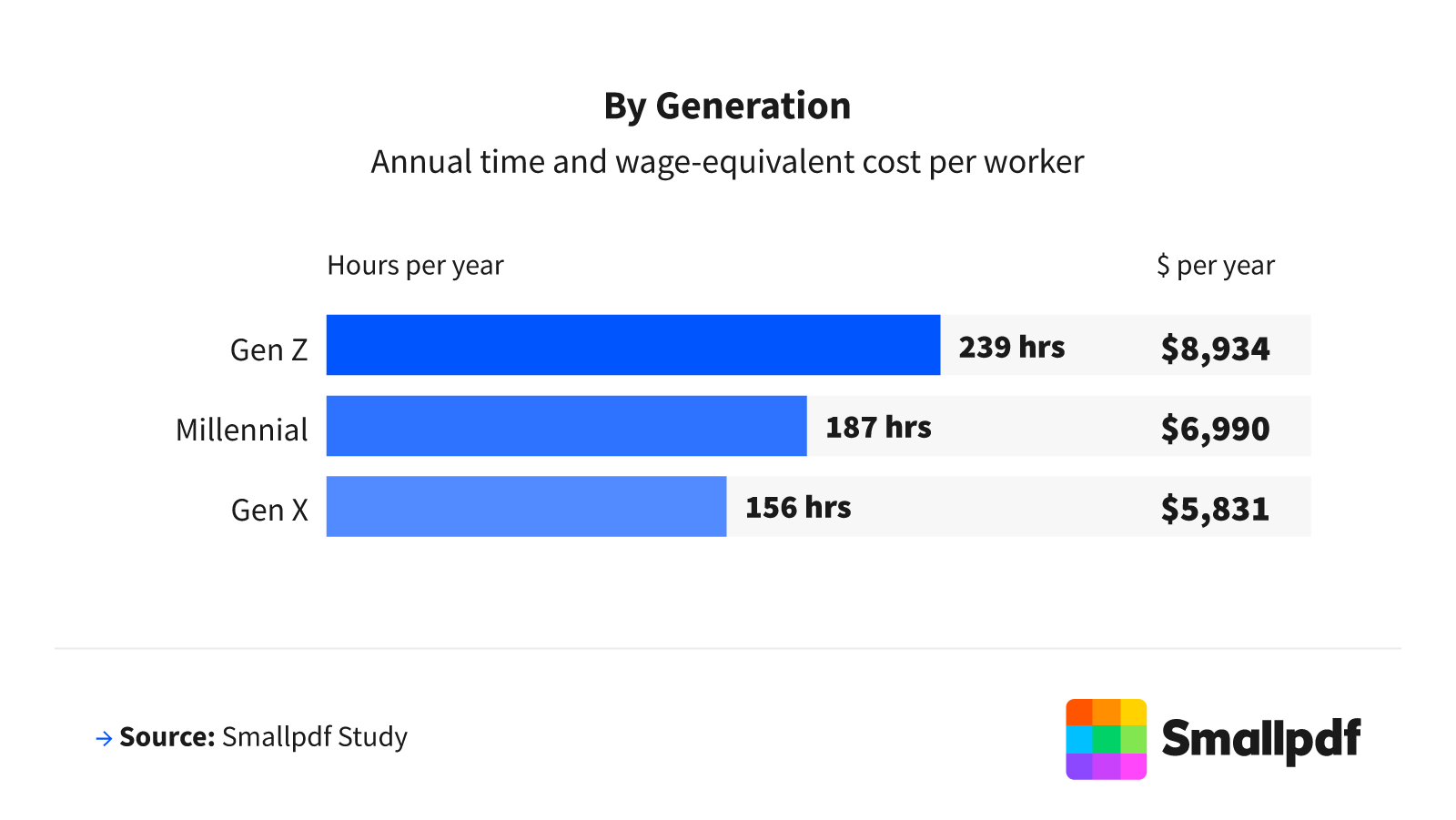
Gen Z workers waste the most time and money on PDF tasks, losing 239 hours per year, equivalent to $8,934 in lost productivity per worker.
Roughly 4 in 5 U.S. workers (81%) rank editing limitations among their top 3 most frustrating PDF issues.
Over 2 in 5 U.S. workers (42%) have printed a PDF, edited it by hand, and scanned it back in because editing the digital version was too difficult. For 35% of those affected, this happens monthly or more often.
In the past year, U.S. workers reported a wide range of consequences caused by PDF problems:
27% have abandoned a task altogether because of a PDF issue, with 21% experiencing it monthly or more often.
26% have delayed a colleague or team because of a PDF problem, and 28% of those affected say it happens monthly or more often.
10% of U.S. workers have missed a deadline because of a PDF. Managers are the most likely (15%) and individual contributors the least (8%). Among those affected, 28% say it happens monthly or more often.
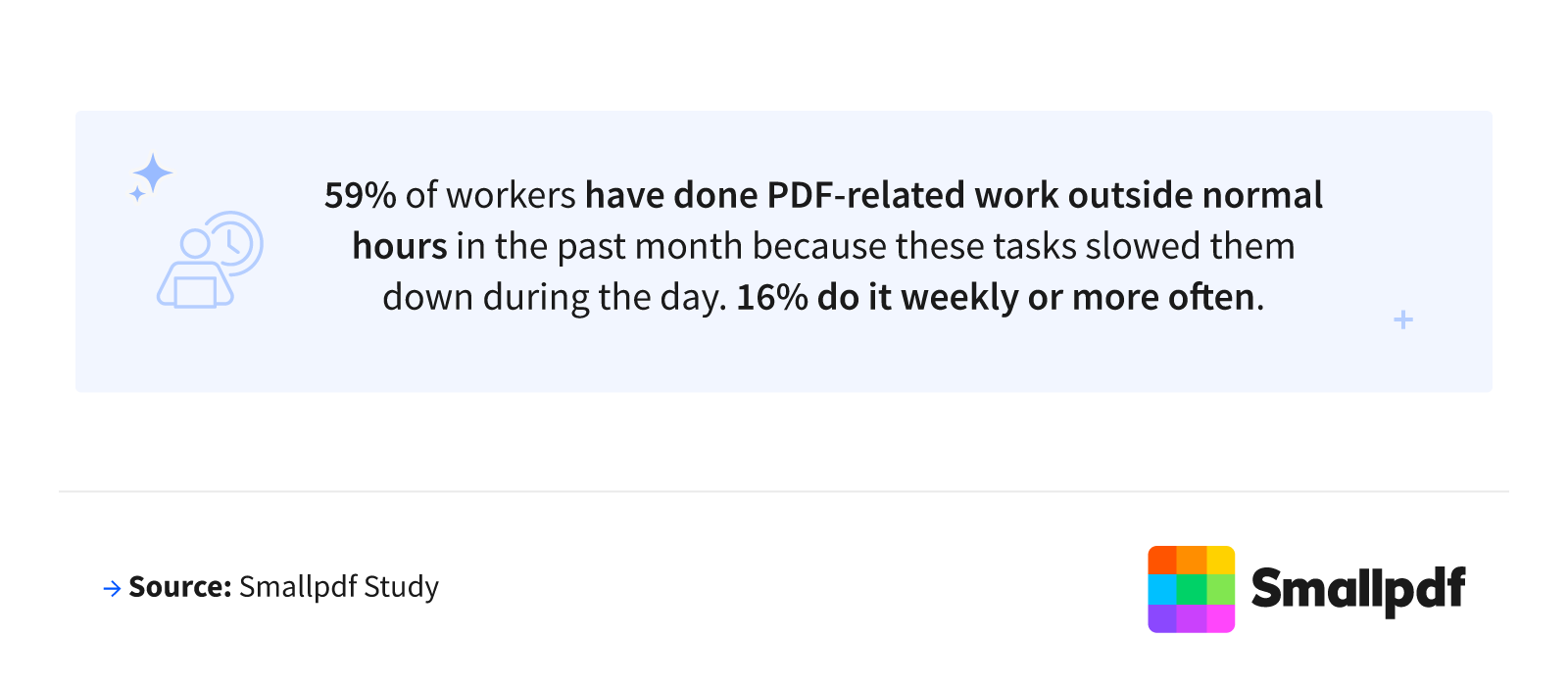
Workers Are Turning to AI for PDF Tasks, Despite the Risks
AI tools are showing up everywhere in modern workflows, but convenience often comes with hidden trade-offs around accuracy, privacy, and trust. The same caution applies as more workers reach for AI to handle PDF tasks.
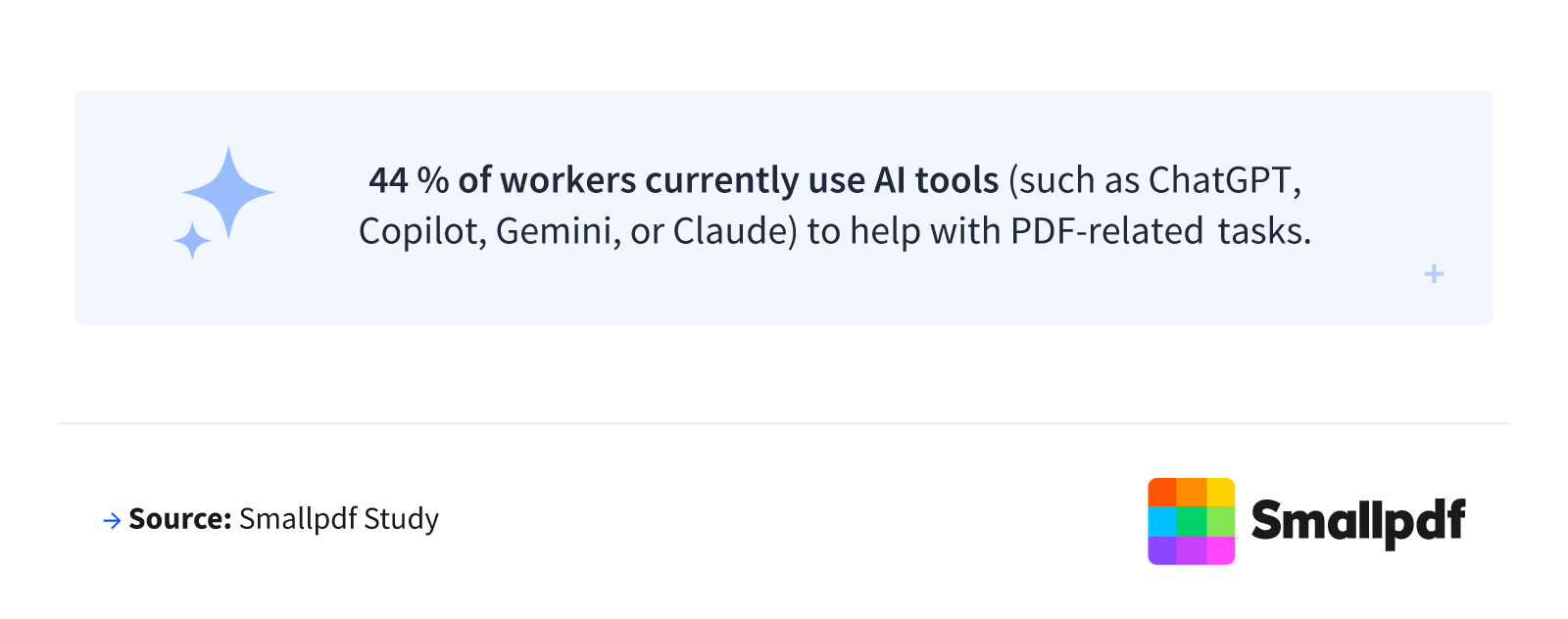
44% of U.S. workers currently use AI tools to help with PDF tasks. By industry, finance leads at 54%, followed by IT (53%) and healthcare (48%).
Managers are the most likely to use AI in this way (54%), and individual contributors are the least likely (37%).
Gen Z is the most likely to currently use AI tools to help with PDF tasks at 52%, followed by millennials (43%) and Gen X (42%).
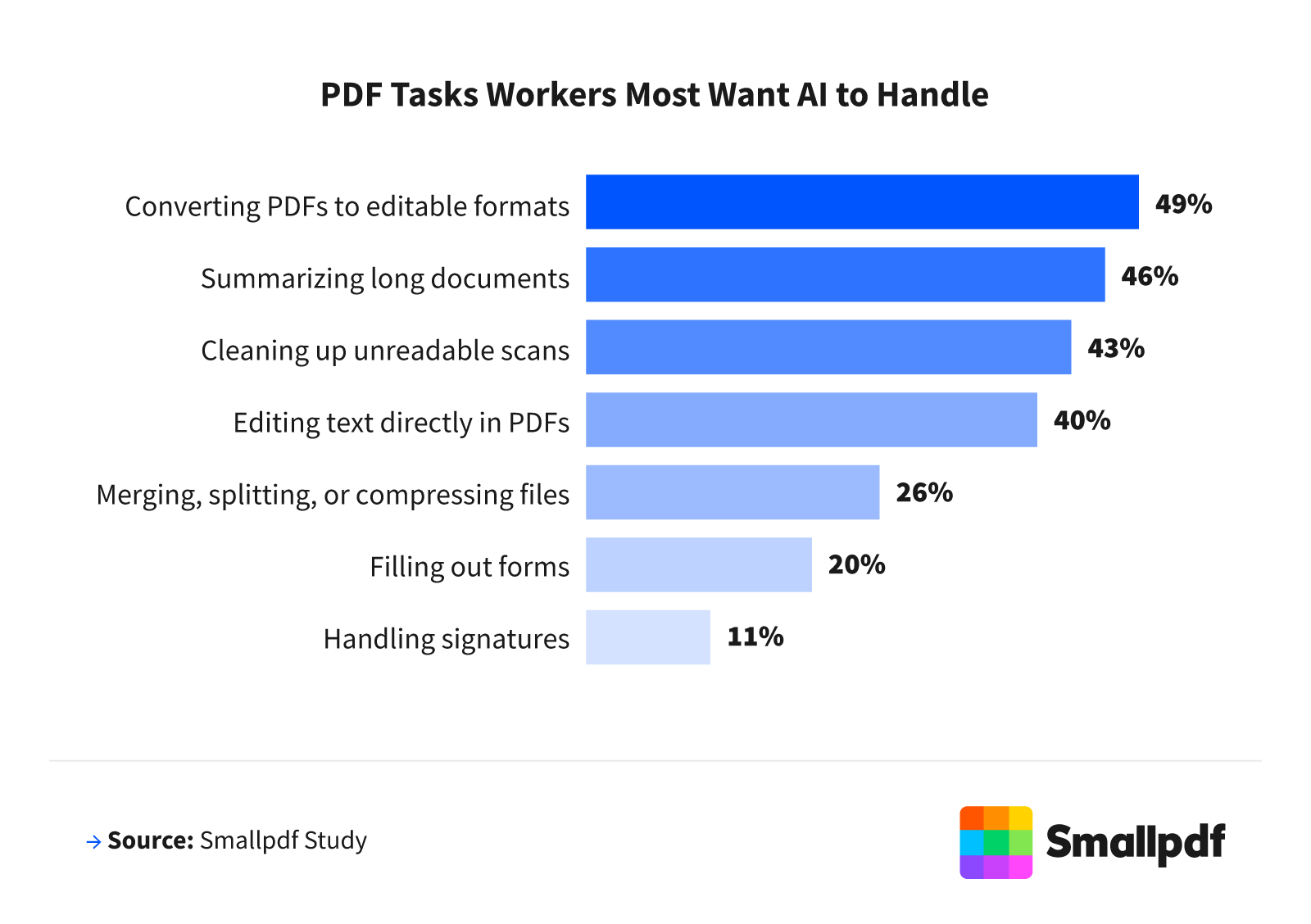
Nearly half of U.S. workers (49%) most want AI to convert PDFs into editable formats, making it the top-ranked unmet demand.
Gen Z workers want AI to convert PDFs to editable formats more than any other group, with 52% naming it their top desired AI fix, followed by summarizing long documents (46%) and cleaning up unreadable scans (45%).
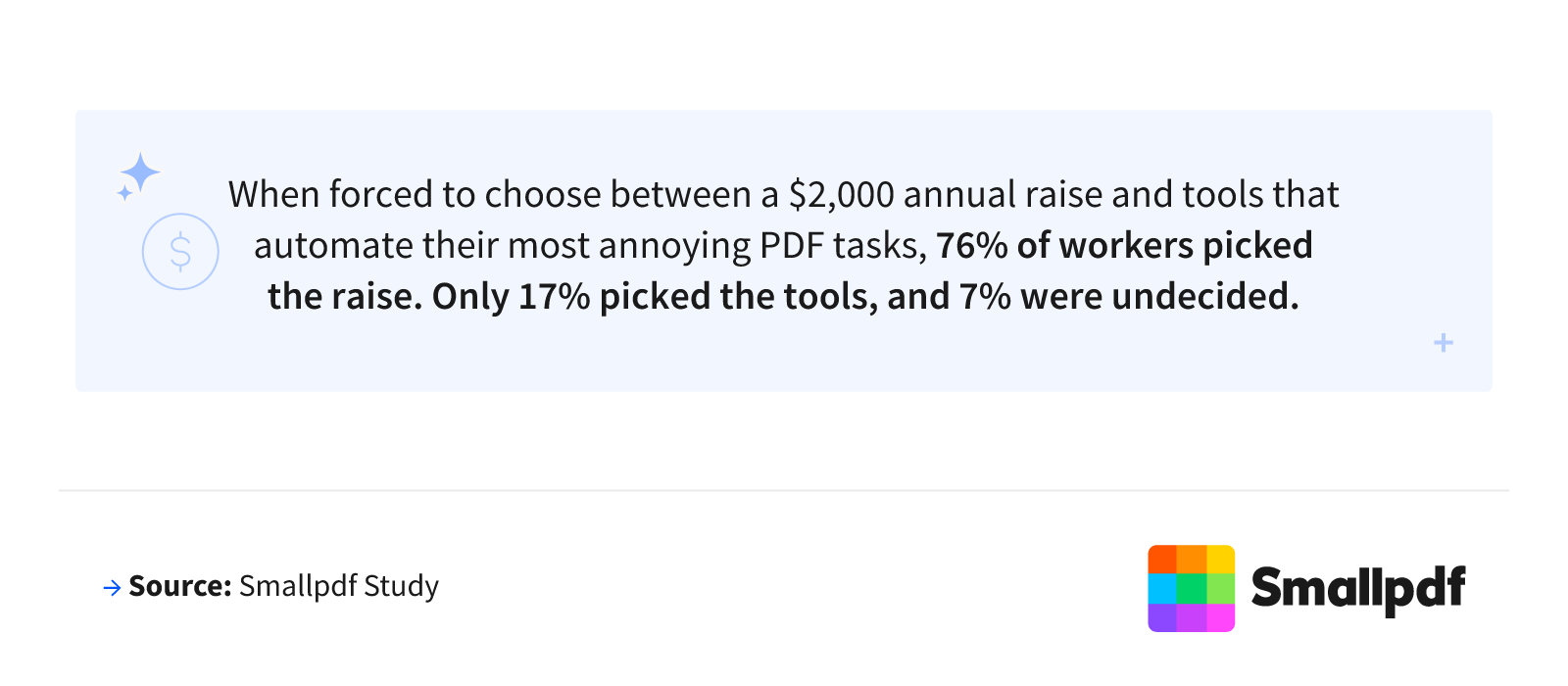
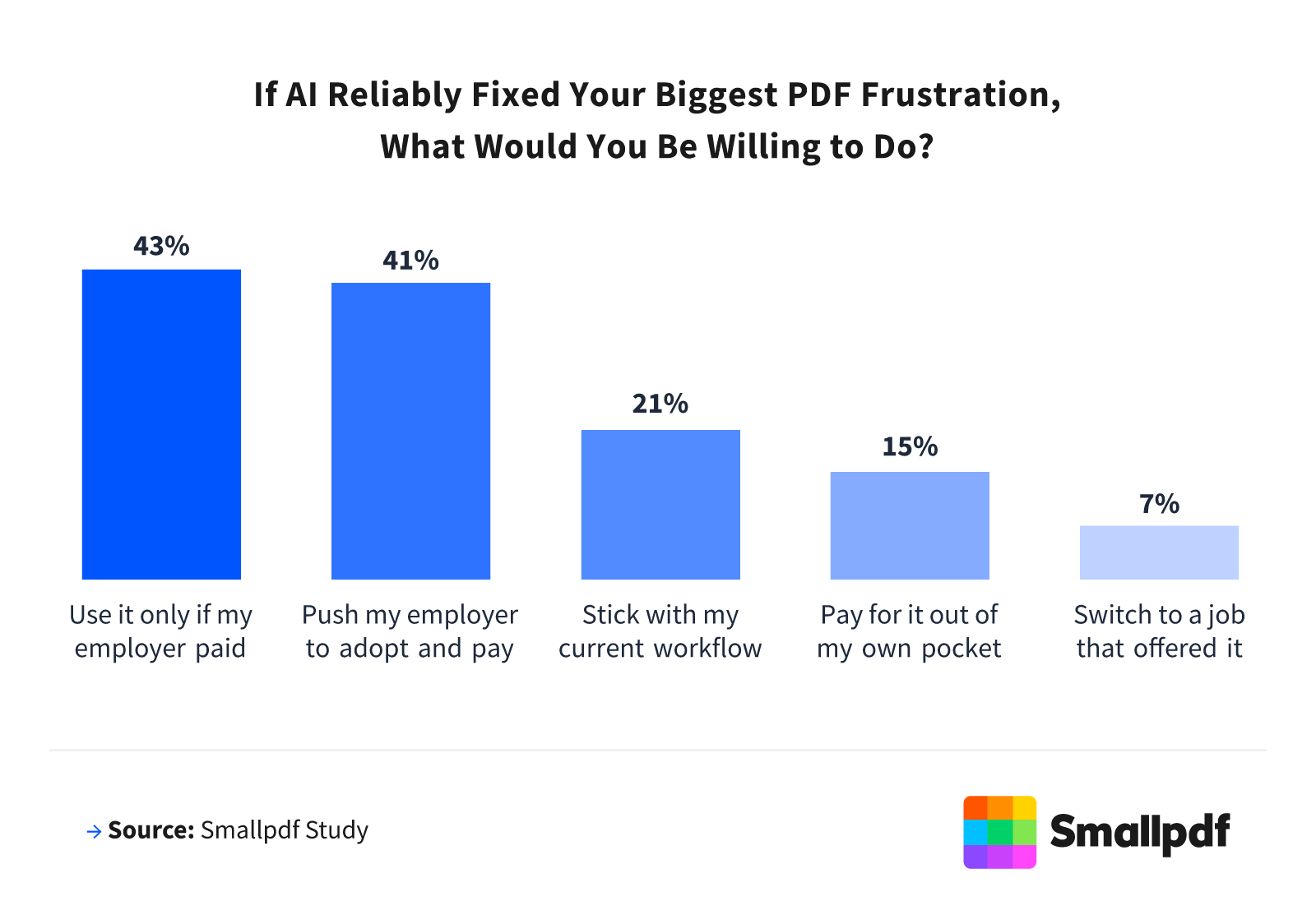
11% of Gen Z workers would switch to a job that offered an AI tool that fixed their biggest PDF frustration, the most of any generation.
Millennials are the most likely to wait for their employer to pay, 44% would only use an AI fix if their employer covered the cost, slightly more than Gen X (42%) and Gen Z (40%).
Simplify PDF Work With Smallpdf's ChatGPT App
Many of these challenges can be solved with Smallpdf's ChatGPT app. Without ever leaving ChatGPT, you can compress PDFs for email or submission, convert PDFs to editable Word files using OCR, and convert images, Word, Excel, and PowerPoint files to PDF. When you're ready to do more, continue your work on the Smallpdf website to merge, sign, edit, and beyond.
Methodology
We surveyed 1,005 U.S. professionals about their experiences with PDF work, including time spent on PDF tasks, the frustrations and disruptions caused by PDF issues, their use of AI tools to help with these tasks, and what they would be willing to do for an automated solution. Respondents represented a mix of industries, job functions, and seniority levels. Respondents spanned individual contributors (54%), managers (32%), and senior leadership (14%). The generational breakdown was 54% millennials, 25% Gen X, 16% Gen Z, and 5% baby boomers.
Financial cost calculated using the U.S. Bureau of Labor Statistics' Average Hourly Earnings for All Employees on Total Private Nonfarm Payrolls ($37.38, March 2026, BLS Table B-3), multiplied by survey-reported hours per week and 52 weeks. Industry-specific figures use BLS Table B-3 (March 2026) for Information ($54.61) and Financial Activities ($49.02), and BLS Occupational Employment and Wage Statistics (May 2024) for Government, Education, and Healthcare sector wages. Data was collected in April 2026.
About Smallpdf
Smallpdf helps millions of professionals and businesses simplify document management with fast, secure, and easy-to-use tools. From converting and compressing PDFs to editing and e-signing, Smallpdf streamlines everyday workflows. Whether you're fixing formatting issues or preparing files to share, Smallpdf makes working with documents more efficient.
Fair Use Statement
This content may be used for noncommercial purposes only. If shared, please include proper attribution with a link back to Smallpdf.