- Home
- ›
- ›The Freelancer Freedom Index 2026: AI Saved the Work, Not the Admin
The Freelancer Freedom Index 2026: AI Saved the Work, Not the Admin
AI transforms how freelancers work, but someone still has to chase the invoice.
AI cuts hours from creative work, but freelancers still lose 204 of them every year to paperwork.
Freelancers can draft a proposal in five minutes with AI now. Then they spend the next two hours formatting it as a PDF, chasing a signature, and following up on an invoice from six weeks ago. Smallpdf's 2026 survey of 397 freelancers found AI made the creative work faster but barely touched the paperwork around it.
Key takeaways
On average, freelancers lose 204 hours a year to admin and paperwork, even with AI in their toolkit.
More than half of freelancers say admin work is costing them potential income, an average of nearly $6,800 a year.
Freelancers reach for AI on admin tasks (70%) more than on the work clients pay them for (65%), yet nearly half (48%) say AI has done little to reduce their admin workload.
Nearly 1 in 3 freelancers (31%) lost a client or undercharged for work in the past year due to paperwork friction.
Formatting documents is the admin task that eats the most freelance time each week (38%), beating out drafting proposals (24%) and managing client approvals (20%).
Nearly 1 in 4 freelancers (24%) wait 2 weeks or more to get paid after sending an invoice.
Just over 1 in 7 freelancers (15%) say 5% or more of the money they invoiced in the past year went unpaid or had to be written off.
About 1 in 7 freelancers (14%) consider quitting freelancing because of the admin burden.
Where AI Fell Short of the Hype
Most freelancers have AI in their workflow. What it did for billable work and what it did for paperwork are not the same story.
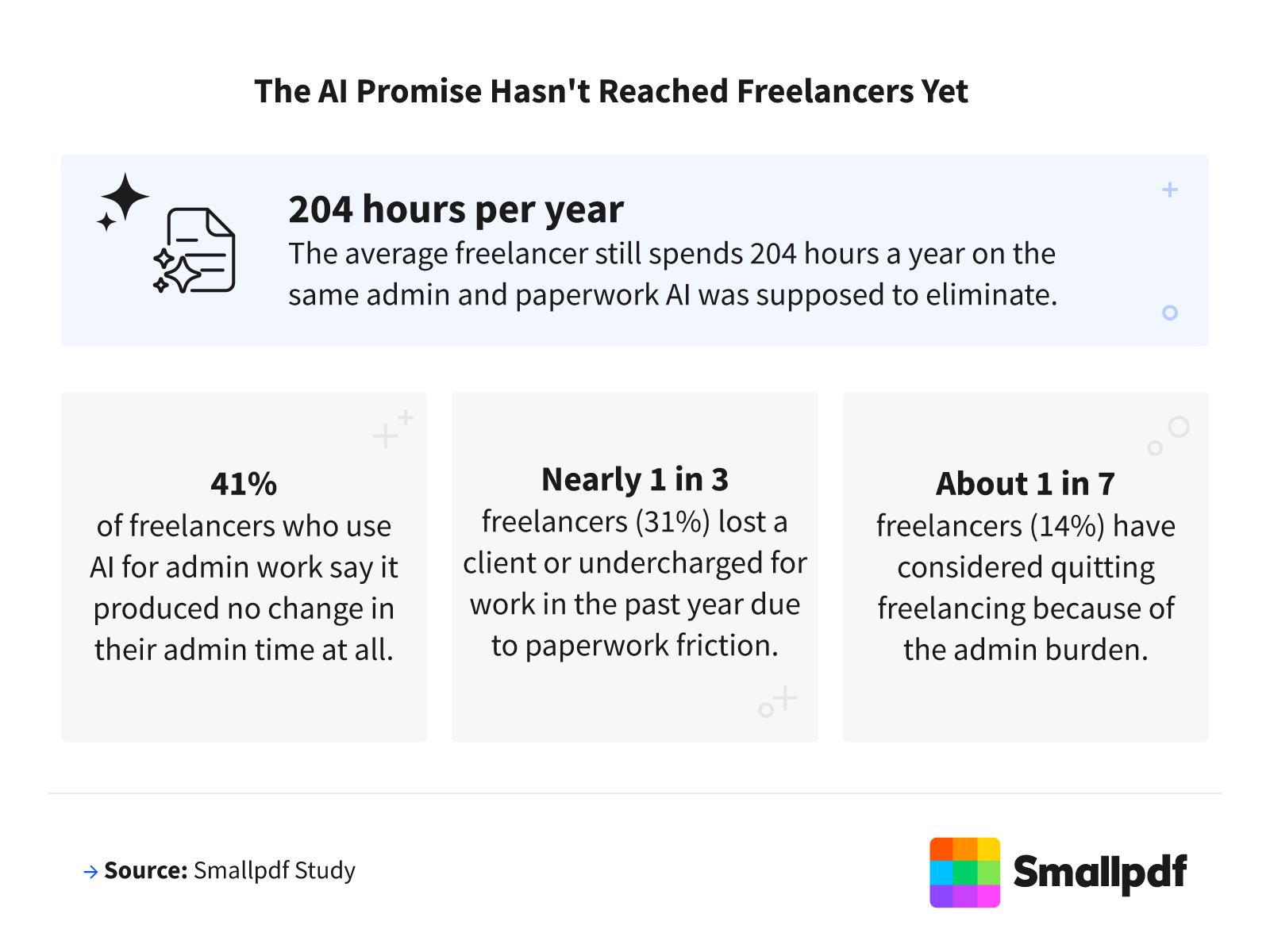
7 in 10 freelancers (70%) reach for AI on admin tasks, and 65% use it for the work clients pay them for.
More than 2 in 3 freelancers who use AI for admin (67%) say it cuts their admin time by less than 25% or does not change it at all.
Nearly half of freelancers (48%) agree AI has done little to reduce their admin workload.
More than half of solopreneurs (58%) say AI has done little to reduce their admin workload, compared with 46% of full-time freelancers.
More than half (56%) say they could earn more in a year if admin tasks took zero time, and 13% put that figure at 26% or more.
Nearly 4 in 5 millennial freelancers (79%) work on admin outside normal business hours, compared with 57% of Gen X.
More than 1 in 3 side hustlers running freelance work alongside a full-time job (36%) lost a client or undercharged because of paperwork friction in the past year.
More than 1 in 3 millennial freelancers (35%) lost a client or undercharged due to paperwork friction, compared with 24% of Gen X.
The Hidden Cost of Waiting on Clients
Even when freelancers stay on top of their end, the rest of the document chain often stalls somewhere else. Most of the delay sits between the moment an invoice is sent and the moment it gets paid.
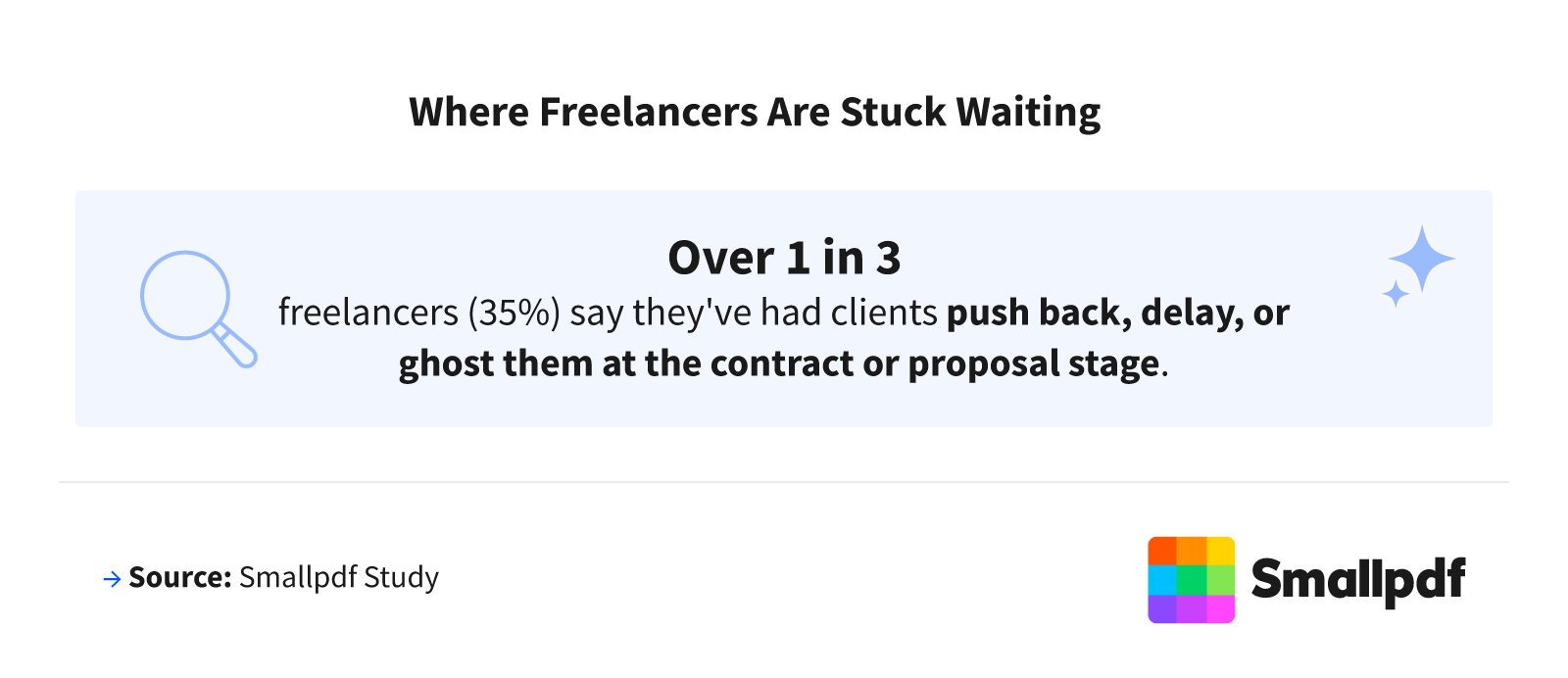
More than 1 in 3 freelancers (35%) say clients pushed back, delayed, or ghosted them at the contract or proposal stage.
Among Gen Z freelancers, 44% report clients pushing back, delaying, or ghosting them at the contract stage, compared with 26% of Gen X.
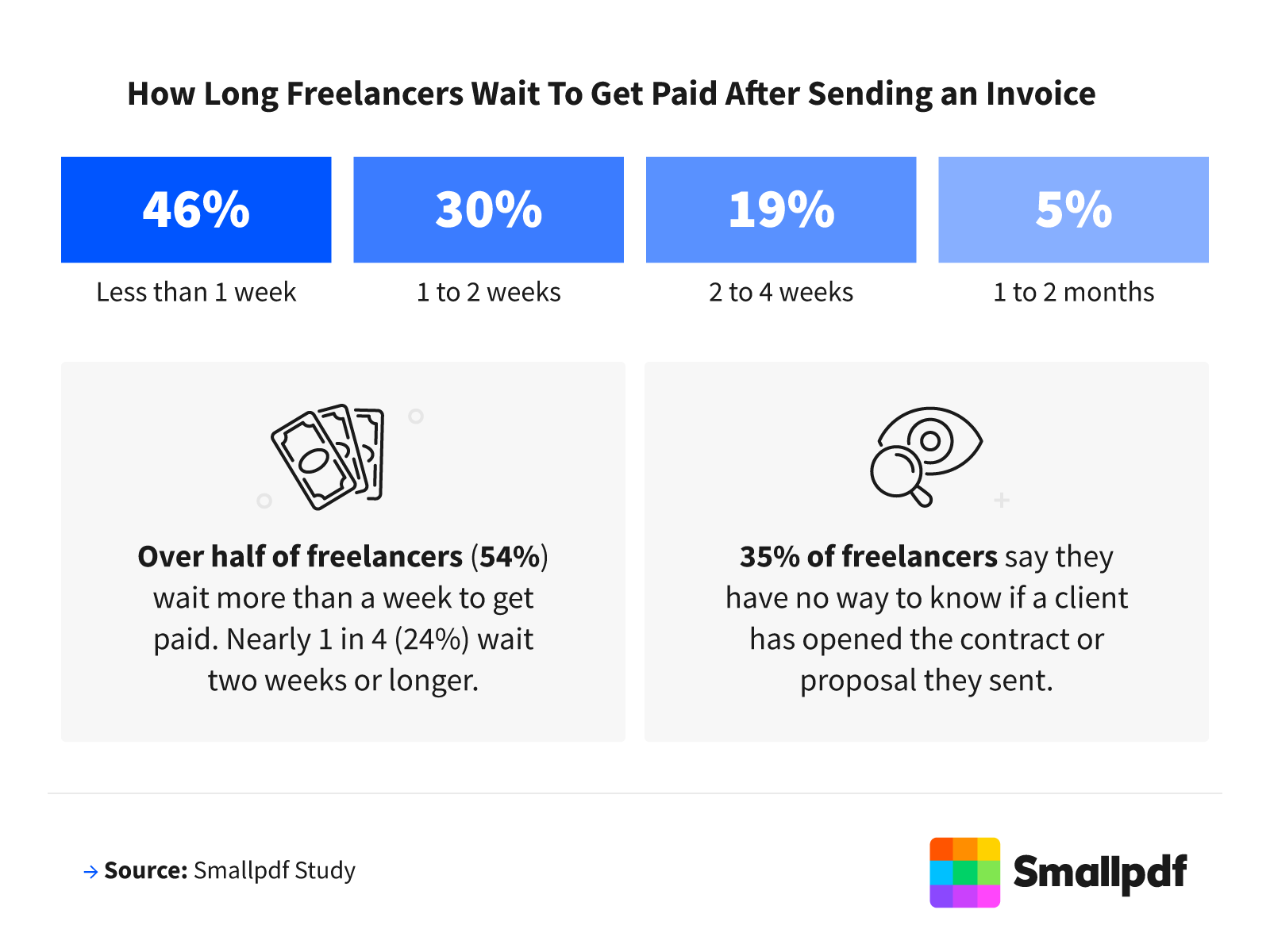
More than half of freelancers (54%) wait more than a week to get paid after sending an invoice, and nearly 1 in 4 (24%) wait 2 weeks or longer.
Nearly 1 in 3 Gen X freelancers (31%) wait 2 weeks or more to get paid, the longest wait of any generation.
More than 1 in 3 freelancers (35%) say they have no way to know if a client actually opened the contract or proposal they sent.
Among Gen Z freelancers, 44% said they have no way to know if a client opened the contract or proposal, compared with 32% of Gen X.
One in 5 freelancers (20%) say they would accept a 10% pay cut if they never had to do admin again.
Just over 1 in 7 freelancers (15%) say 5% or more of the money they invoiced went unpaid or had to be written off.
One in 7 freelancers (14%) consider quitting freelancing because of the admin burden.
What's Actually Working: 5 Changes Freelancers Are Making To Cut Admin Time
When we asked freelancers what single change had made the biggest difference to their admin workload, the answers clustered around five practical moves. None of them are silver bullets, but together they map a realistic playbook for clawing back hours.
1. Build Reusable Templates Instead of Writing From Scratch Every Time
Templates and reusable frameworks for proposals, contracts, follow-ups, and invoicing came up more often than any other practical fix, with mentions cutting across every generation and worker type.
‘Using a framework and template for repetitive tasks.’ — Millennial side hustler, healthcare
‘Using ChatGPT to organize thoughts and create templates for future use, or to gauge budgeting and pricing.’ — Gen Z freelancer, photography
2. Adopt E-Signature Tools To Cut the Signature Wait Time
E-signature adoption came up repeatedly as a high-leverage change, especially for freelancers in industries that rely on contracts.
‘Adopting e-sign, it makes it so much faster.’ — Millennial freelancer, photography
‘Using an e-sign tool and having all of my contracts saved so I can just send them out, know when they've been read, and get them signed.’ — Millennial freelancer, real estate
3. Centralize Documents and Workflow in One Place
Freelancers who pull their files, invoices, and references into a single platform report real-time savings, particularly for full-time solo operators juggling multiple clients.
‘Organizing documents into one place to reference easier.’ — Millennial freelancer, education
‘Use platforms that do the work for me. It's less stressful.’ — Gen X solo operator, writing
4. Outsource What Isn’t Worth Your Time
This was the least common change reported, but the freelancers who delegate describe it as the highest-impact move they had made.
‘Hiring an accountant has saved me lots of time and headaches and makes me more confident that things are in order.’ — Gen X freelancer
5. Use AI for the Specific Tasks It Actually Solves
The freelancers who got the most value from AI weren't using it broadly. They were using it for narrowly defined tasks like email drafts, repetitive writing, and template generation.
‘Switching to the latest AIs and learning what AI is best for specific tasks.’ — Gen X side hustler, IT
‘Using AI in some ways, less switching and stressing.’ — Gen Z side hustler, design
How Much Is Admin Costing You?
Want to see where your own admin time goes? The Freelance Admin Time Calculator estimates how many hours and dollars you're losing each month based on the number of proposals, contracts, invoices, and clients you handle.
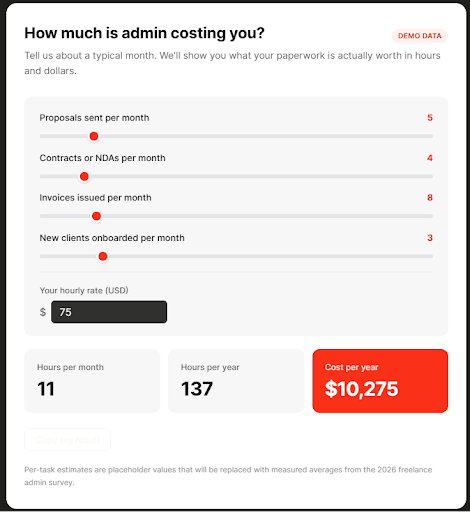
Calculate Admin Cost
What Freelancers Can Take Back
AI raised expectations for what a one-person operation could handle. The savings landed quickly on the work clients pay for but barely on the paperwork that makes that work payable. Freelancers who clawed back hours did it by changing the process before reaching for another tool.
Methodology
We surveyed 397 freelancers, consultants, and solo operators about how they spend their working hours, including time lost to admin and paperwork, the impact of AI tools on creative versus administrative work, the document tasks slowing their workflows, and the financial cost of paperwork friction on their businesses. Respondents represented a mix of industries, work types, and tenure levels. The generational breakdown was 48% millennials, 28% Gen X, 19% Gen Z, and 5% baby boomers. The gender breakdown was 61% women, 37% men, and 2% non-binary or gender non-conforming.
Per-task time benchmarks in the Freelance Admin Time Calculator were derived by dividing each respondent's reported weekly time per admin task by their reported monthly task count, converting to minutes per instance, and taking the interquartile-range filtered mean across qualifying respondents.
Open-ended numeric responses were calculated using the interquartile range (IQR) method to limit the influence of outliers. Demographic findings are reported only for segments representing at least 5% of the total sample. Percentages may not sum to 100% due to rounding. Data was collected in April 2026 through CloudResearch Connect.
About Smallpdf
Smallpdf helps millions of professionals and businesses simplify document management with fast, secure, and easy-to-use tools. From converting and compressing PDFs to editing and e-signing, Smallpdf streamlines everyday workflows. Whether you're fixing formatting issues or preparing files to share, Smallpdf makes working with documents more efficient.
Fair Use Statement
This content may be used for noncommercial purposes only. If shared, please include proper attribution with a link back to Smallpdf.
Related Articles